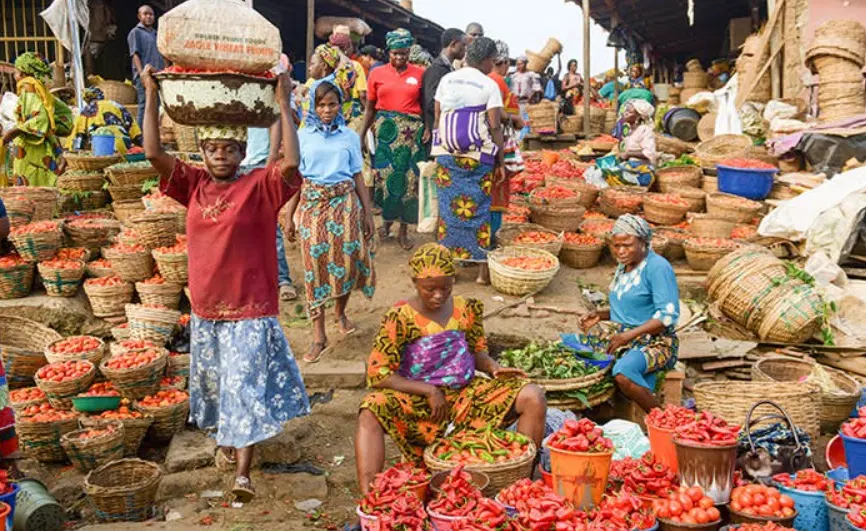
Two-and-a-half years into the Federal Government’s (FG) economic reform programme, a closer look reveals a mixed picture. While the government has hailed improvements in macroeconomic indicators—rising GDP, moderating inflation, stable exchange rates, and growing external reserves—many economists and stakeholders warn that these gains have yet to translate into tangible benefits for ordinary Nigerians.
Economic growth “largely on paper”
Dr. Andrew Mamedu, Country Director of ActionAid Nigeria, argued that the claimed economic turnaround remains mostly statistical. “Some macro indicators show improvement—slowing inflation, exchange rate stability, and marginal growth in non-oil revenue—but these alone do not prove that reforms have meaningfully improved Nigerians’ lives,” he said. According to Mamedu, most growth is concentrated in a few sectors like oil and services, while agriculture, manufacturing, and small businesses—the main job creators—continue to struggle.
He noted that recent drops in food prices are largely due to border openings and imports rather than local production, which has left farmers facing losses. Similarly, while fuel subsidy removal has improved government revenue, it has deepened hardship for low-income households, with savings not clearly reinvested into essential public services.
Mamedu suggested a combination of sound economics, social protection, and job creation to make growth inclusive. “Expanding targeted cash transfers and redirecting savings from fuel subsidies to public services would protect poor households and sustain consumer spending,” he said, adding that investments in agriculture, rural infrastructure, and SMEs are essential for lasting change.
Stability versus progress
Prof. Magnus Kpakol, former economic adviser to President Olusegun Obasanjo, agreed that while the economy has stabilized, real progress is lacking. “Stability is not enough. We need performance. If people are stabilized but still living in poverty, what kind of growth is this?” he asked. Kpakol warned that Nigeria’s productivity remains low, and unless local communities are empowered to fully own and exploit their resources, growth will remain uneven and insufficient for achieving the $1 trillion economy target by 2030.
He also proposed targeted subsidies for vulnerable groups, including transport operators, to ease the cost-of-living pressures on ordinary Nigerians.
Mixed signals from industry
Segun Ajayi-Kadir, Director-General of the Manufacturers Association of Nigeria (MAN), acknowledged improvements in manufacturers’ confidence, noting a gradual recovery in the sector. “The stabilization path has been cleared; what lies ahead is accelerated growth, with manufacturing as the nucleus of Nigeria’s growth strategy,” he said.
Small business owners echoed caution. Dr. Femi Egbesola, President of the Association of Small Business Owners of Nigeria (ASBON), stressed that reforms are promising but not yet fully effective. “Economic soundness is not only about statistics—it’s about the lived experiences of citizens and small business owners. Until they see real relief, the reforms remain incomplete,” he said.
Reform paradoxes and social impacts
Economist Dr. Amase Justin highlighted several paradoxes: while GDP is growing, poverty and inflation remain high; exchange rate unification and subsidy removal have yet to produce tangible welfare benefits; and debt continues to rise even as revenue improves. “Reforms have addressed structural distortions but created short-term welfare losses. Gains must be complemented by infrastructure growth, social safety nets, and security improvements to be truly transformative,” he said.
Financial analyst David Adonri warned that despite positive macro indicators, inflation remains double-digit, interest rates are high, and debt pressures persist, meaning it is premature to claim the economy has “turned the corner.”
Public policy analyst Clifford Egbomeade similarly emphasized that improvements are visible in charts but not in households. Real wages remain depressed, food and transport costs remain high, and living standards have not significantly improved. He argued that macroeconomic gains must now translate into tangible benefits: affordable credit for SMEs, enhanced agricultural productivity, and expanded social protection.
Conclusion
Overall, while Nigeria’s economic reforms have achieved notable macroeconomic stabilization and some structural improvements, real progress remains uneven. Experts call for a focus on inclusive growth, targeted social protection, and policies that improve citizens’ welfare. In short, the economy may look healthier on paper, but for millions of Nigerians, the lived reality is still far from the government’s optimistic assessment.