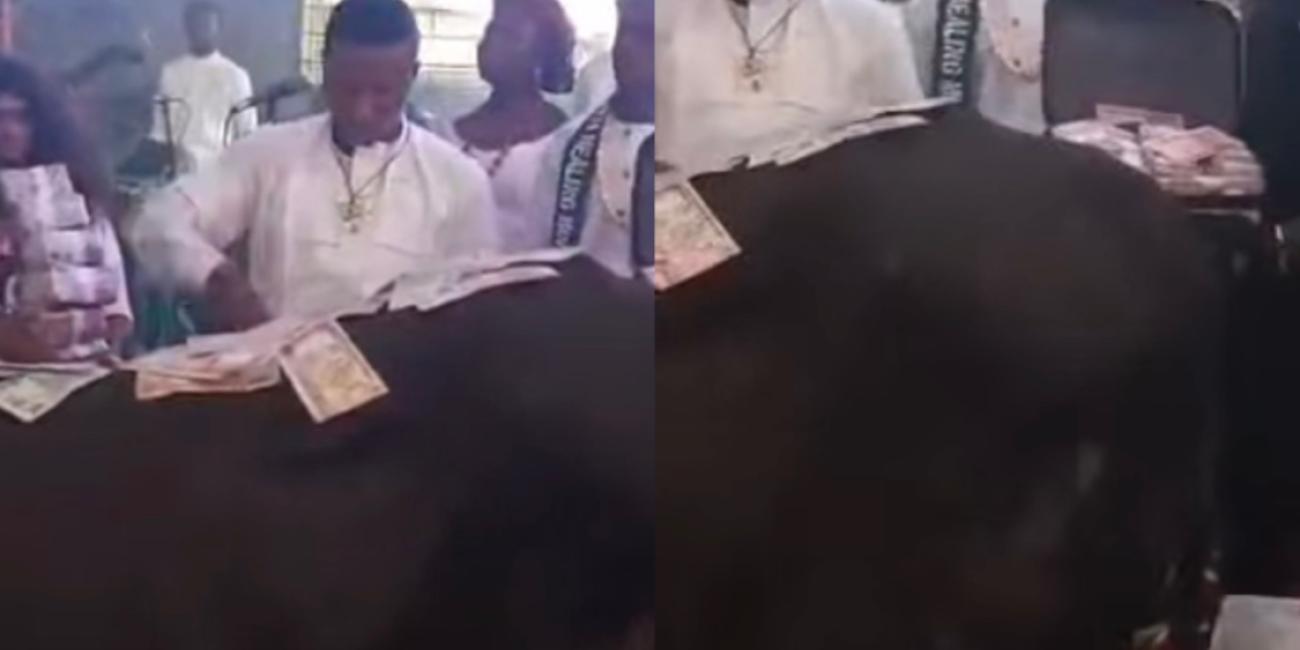
The Economic and Financial Crimes Commission (EFCC) has opened an investigation into a viral video showing an unidentified man spraying bundles of naira notes inside a church in Warri, Delta State.
EFCC spokesperson, Dele Oyewale, confirmed the development, stating that the commission is already reviewing the footage. “The matter is under investigation,” he told PUNCH.
The viral clip, which has triggered widespread public outrage, shows the man spraying various denominations—including ₦200, ₦50, and ₦20—on a dark-coloured cow that was brought into the church for what appeared to be a thanksgiving ceremony. A woman standing beside him held a large pile of cash as he continued spraying freely.
The atmosphere inside the church resembled a social party: hip-hop music blared from speakers while the pastor sang in Urhobo, and a hype man repeatedly hailed the celebrant as a “young billionaire,” encouraging the congregation to applaud him as he tossed money into the air.
The video has since sparked strong reactions across social media. A user identified as Fortis wrote, “This is very offensive to watch. More worrisome is the fact that children are even in this congregation. This is indeed disgraceful.”
Another user, @BishopBoye, referenced the biblical account of Jesus cleansing the temple, commenting, “They didn’t do 1/10 of what these people are doing before Jesus flogged them at the temple. Two thousand years later, just look at this.”
Others expressed similar concerns. “Please don’t call this a church. No real church will tolerate this nonsense,” said Ituma Sunny. Asiegbu Odenigbo added, “Yahoo boy doing thanksgiving in a yahoo church for the yahoo pastor.”
John Vianney Dominic described the act as “Baal worship,” while another user, Prince Ade-Chameleon, alleged that “these aren’t yahoo boys but kidnappers.”
Attempts to reach the Delta State Police Public Relations Officer, SP Bright Edefa, were unsuccessful, as calls to his mobile phone went unanswered.
Naira abuse has remained a persistent problem in Nigeria, particularly at social and religious gatherings where spraying money is seen as a display of wealth. The act violates Section 21 of the Central Bank of Nigeria Act, which prohibits the tampering and mishandling of the national currency.
In recent years, the EFCC has intensified its crackdown on currency mutilation, making several arrests and securing convictions. The agency maintains that the abuse of the naira undermines its dignity, encourages illicit behaviour, and contributes to broader economic disorder.