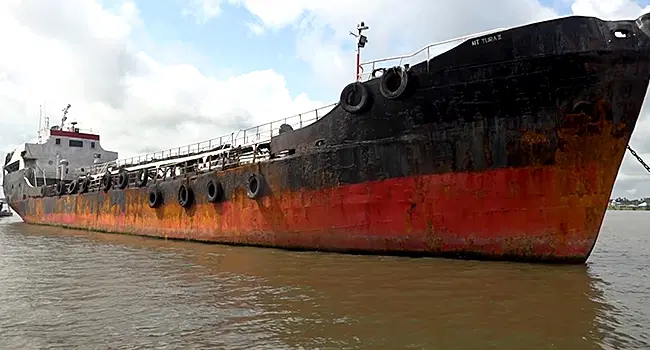
The United States Coast Guard, working alongside the U.S. Navy, has intercepted a Nigerian-owned supertanker, Skipper, over allegations ranging from crude oil theft to piracy and drug trafficking. The vessel—a 20-year-old Very Large Crude Carrier—is linked to Nigeria-based Thomarose Global Ventures Ltd., although records list its registered owner as Triton Navigation Corp. in the Marshall Islands. Authorities noted that the tanker was unlawfully flying the Guyanese flag at the time of the operation.
Guyana’s Maritime Administration Department later clarified that Skipper is not listed in its national ship registry, confirming that the ship used the country’s flag without permission. U.S. security officials stated that the interception was executed under American law enforcement authority, with President Donald Trump publicly announcing the operation. Investigators are also probing allegations that the tanker was transporting a large consignment of hard drugs and working within a network linked to suspected Iranian and Islamist-backed money launderers.
Further checks revealed that Thomarose Global Ventures, believed to be the vessel’s Nigerian owner, is currently inactive according to Corporate Affairs Commission records. The company’s listed address in Warri, Delta State, shows no active phone numbers or operational details, raising additional questions about its activities and ownership structure. Maritime experts argue that if the tanker indeed departed from Nigeria, the development exposes weaknesses in the country’s Port State Control system.
Industry leaders expressed shock at the situation, noting that details surrounding the vessel’s movement and ownership remain unclear. Several stakeholders, including officials from OGSPAN, SOAN, and former NIMASA leadership, said they were awaiting verified information before making formal comments. NIMASA itself stated that it has no official report on the incident and requested a formal enquiry for proper clarification.
A Port Harcourt-based energy analyst criticised persistent loopholes in Nigeria’s maritime and oil monitoring systems, saying that despite numerous agencies and private contractors, crude oil theft continues to thrive. According to the analyst, such illegal activities undermine national revenue and threaten long-term economic stability.
Earlier this year, NEITI reported that Nigeria lost 13.5 million barrels of crude—valued at $3.3 billion—to theft and pipeline vandalism between 2023 and 2024. NEITI’s Executive Secretary highlighted that the revenue lost to sabotage could have funded a full-year federal health budget or expanded energy access to millions of homes. The agency continues to push governance reforms, enhanced transparency, and improved public access to extractive sector data in a bid to reduce corruption, illicit flows, and operational inefficiencies.