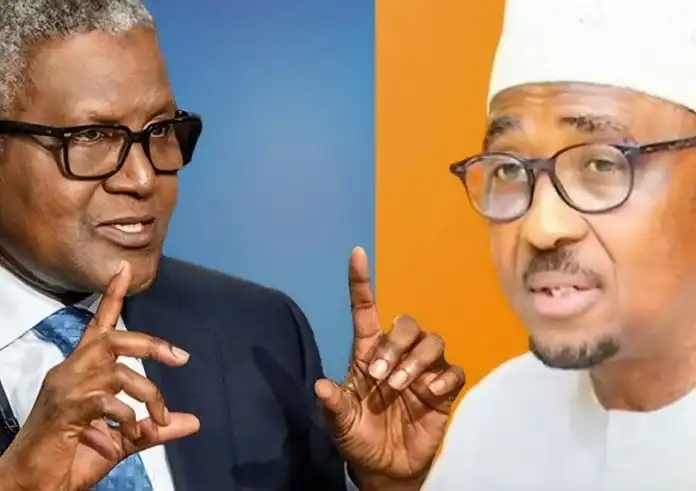
The Chief Executive Officer of the Nigerian Midstream and Downstream Petroleum Regulatory Authority (NMDPRA), Engr. Farouk Ahmed, has responded to allegations surrounding the funding of his children’s education in Switzerland, which reportedly cost about $7 million.
The controversy followed remarks credited to Aliko Dangote, President of the Dangote Group, who reportedly questioned how Ahmed could afford such expenses on a public servant’s income, suggesting that he was living beyond his means.
In a strongly worded statement titled “A Question of Integrity: Engr. Farouk Ahmed Responds,” dated December 16, 2025, the NMDPRA boss rejected the allegations and openly challenged anti-corruption agencies, including the EFCC and ICPC, to investigate his finances.
Ahmed said the claims required context, stressing that he has spent over 30 years in Nigeria’s petroleum sector, rising through the ranks on merit, not political patronage. According to him, his career began in 1991 as a junior engineer in the former Department of Petroleum Resources, progressing through key technical and regulatory roles before his appointment as NMDPRA chief in 2021.
He explained that three of his four children benefited from merit-based scholarships covering between 40 and 65 per cent of their tuition, a claim he said can be verified. He also disclosed that his late father, a businessman, had set up education trust funds for his grandchildren before his death in 2018, in line with family traditions.
Ahmed added that when these contributions are combined with his personal savings from decades of public service and cooperative investments available to civil servants, his financial commitments were well within his legitimate means. He noted that his annual compensation as NMDPRA CEO, about ₦48 million including allowances, is publicly available and fully declared.
Emphasising transparency, he said he has consistently submitted asset declarations to the Code of Conduct Bureau since entering public service and authorised investigators to obtain financial records from the schools his children attended.
Beyond the personal defence, Ahmed suggested that the allegations were resurfacing at a sensitive time, when the NMDPRA has tightened regulatory standards, enforced quality controls, and resisted what he described as attempts to undermine regulatory independence in the petroleum sector.
He defended the authority’s decision to grant fuel import licences when local supply falls short, saying it is a legal obligation under the Petroleum Industry Act, not economic sabotage. According to him, relying on a single supply source would expose the country to serious risks.
In a direct challenge, Ahmed called on the Code of Conduct Bureau, the EFCC and the National Assembly to thoroughly investigate his assets, income and professional conduct, pledging full cooperation without conditions.
“I have nothing to hide,” he said, adding that he would not allow personal attacks or pressure from powerful interests to derail regulatory reforms aimed at protecting Nigeria’s long-term energy security.
Concluding his statement, Ahmed maintained that integrity is often tested when reforms disrupt entrenched interests, insisting that history would favour principled regulation over convenience or compromise.