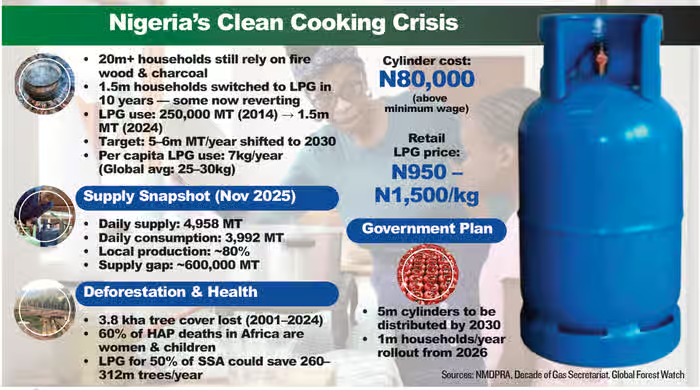
Over 20 million Nigerian households still rely on firewood and charcoal for cooking despite a decade of policy support, rising domestic LPG production, and over $500 million in private investment. While about 1.5 million homes have switched to liquefied petroleum gas (LPG) over the past 10 years, many have reverted to biomass due to high costs, limited last-mile distribution, and poor affordability.
LPG consumption has risen from 250,000 metric tonnes in 2014 to 1.5 million tonnes in 2024, yet it remains far below the federal government’s original target of 5–6 million tonnes, now pushed to 2030. Per capita consumption is about 7 kg per year, compared with a global average of 25–30 kg, highlighting the persistent gap in clean cooking access. Rural and peri-urban households face particular challenges, with poverty and weak retail networks limiting LPG availability.
The National Gas Expansion Programme and Decade of Gas initiative aim to distribute millions of free cylinders to vulnerable households, with a state-by-state rollout targeting one million households annually starting in 2026, aiming for five million homes by 2030. Experts, however, warn that affordability and infrastructure gaps could stall progress, especially as cylinder acquisition remains a major barrier. A standard 12.5 kg LPG cylinder now costs about N80,000, far above the minimum wage.
Rising LPG prices have forced many households, like those in Bayelsa and Abuja, back to charcoal and firewood, despite the health risks from smoke inhalation. Women and children are particularly vulnerable, accounting for 60% of premature deaths associated with household air pollution in Africa. Providing LPG to half of sub-Saharan Africa could save 260–312 million trees annually, illustrating both environmental and public health stakes.
Industry leaders note that supply infrastructure has improved, with companies like Rainoil Gas operating storage depots, trucks, and retail outlets nationwide, while local production now covers 80% of demand. Yet, challenges remain: 600,000 tonnes supply gap, ageing cylinders, poor roads, and inadequate rural distribution hinder access. Experts stress that affordable cylinders, micro-distribution networks, safety enforcement, and public education are crucial to ensure Nigeria’s clean cooking transition succeeds.
Without urgent intervention, high costs and poor access risk making LPG a luxury product, pushing households back to firewood and charcoal, worsening deforestation, environmental degradation, and public health outcomes.