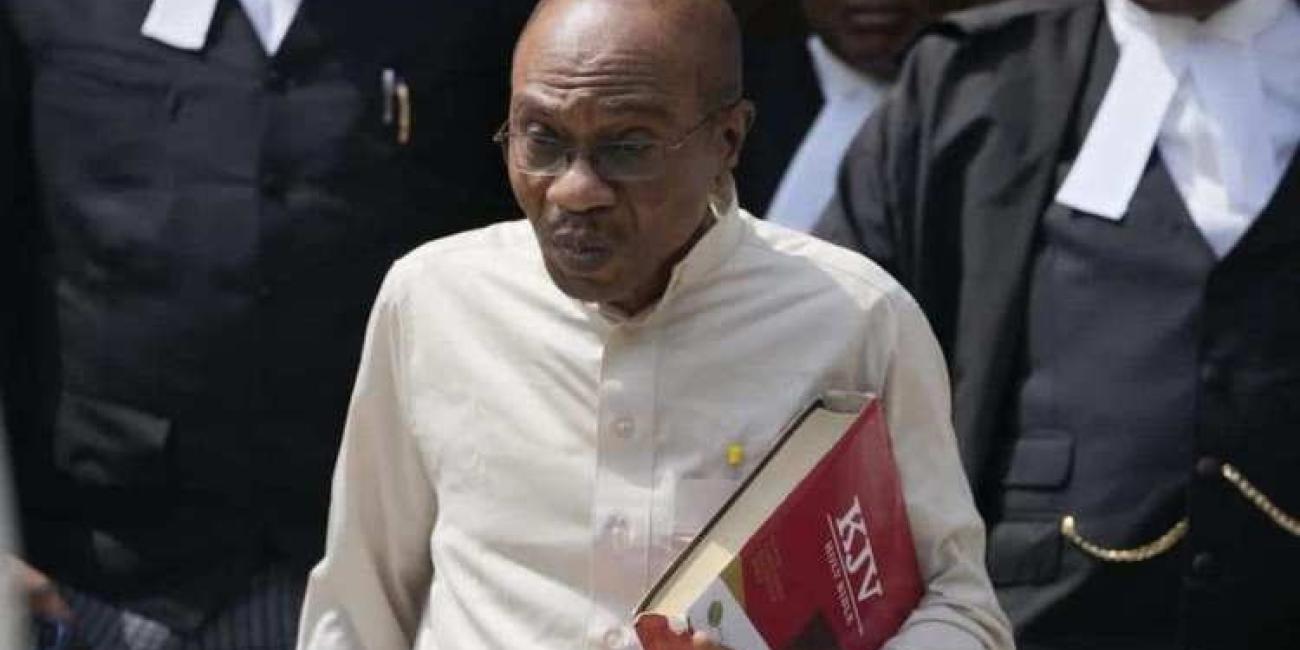
A defence witness has told the Lagos State Special Offences Court in Ikeja that operatives of the Economic and Financial Crimes Commission (EFCC) attempted to pressure one of the defendants in the corruption trial of former Central Bank of Nigeria (CBN) Governor, Godwin Emefiele, into falsely implicating him.
The allegation was made on Thursday by Nnamdi Offial, a legal practitioner, while testifying in a trial-within-a-trial ordered by Justice Rahman Oshodi. The mini-trial is meant to determine whether a statement allegedly made by the second defendant, Henry Omoile, was obtained voluntarily.
Emefiele and Omoile are facing multiple charges including accepting gratification, receiving gifts through agents, fraudulent receipt of property, corruption and conferring corrupt advantages on associates. The charges, brought by the EFCC under the Corrupt Practices and Other Related Offences Act, 2000, involve sums estimated at about $4.5 billion and ₦2.8 million. Both defendants have pleaded not guilty.
While giving evidence, Offial told the court that he was present during Omoile’s interrogation at the EFCC office and witnessed investigators repeatedly pressuring his client to make statements against Emefiele.
According to him, EFCC operatives promised inducements such as bail and possible non-prosecution if Omoile agreed to cooperate by implicating the former CBN governor.
He alleged that the investigators appeared more interested in securing incriminating statements against Emefiele than in allowing Omoile to freely give his own account of events.
Offial further claimed that the statement-taking process was tightly controlled, with EFCC officers dictating responses and rejecting answers that did not align with what they wanted recorded.
“On several occasions, questions were put to the second defendant and he answered, but he was not allowed to write them down because the answers did not conform with what the interrogators wanted. I objected to this repeatedly,” Offial told the court.
The lawyer said after the interrogation on February 26, 2024, EFCC officers informed him that Omoile would remain in detention. When he returned the next day, he discovered that his client was being questioned in his absence, which he said violated standard legal procedure.
He told the court that when he challenged the process, one of the officers, identified as David, reacted angrily, leading to a confrontation that resulted in him being escorted out of the interrogation area.
According to Offial, he was later informed that Omoile would not be released because he refused to cooperate by indicting Emefiele. This, he said, forced him to apply for bail from the EFCC zonal head.
Offial revealed that Omoile was detained for 21 days, prompting him to file a fundamental rights enforcement suit at the Federal High Court in Lagos. He said Justice Muslim Hamza later granted bail but ordered that Omoile be remanded at the Ikoyi Correctional Centre pending the perfection of bail conditions.
However, under cross-examination by the EFCC’s lead prosecutor, Rotimi Oyedepo (SAN), Offial made several key admissions. He confirmed that Omoile was cautioned in his presence before his statement was taken and that the caution was duly signed.
He also admitted that he participated in the statement-taking process, understood its legal implications, did not file any formal petition against the EFCC, and that the court hearing the fundamental rights suit made no finding of misconduct against the commission.
Offial further acknowledged that his client was not physically assaulted during the interrogation.
Justice Rahman Oshodi subsequently adjourned the matter to January 16, 2026, for continuation of the trial-within-a-trial, which will determine whether Omoile’s statement will be admitted as evidence in the main corruption case.