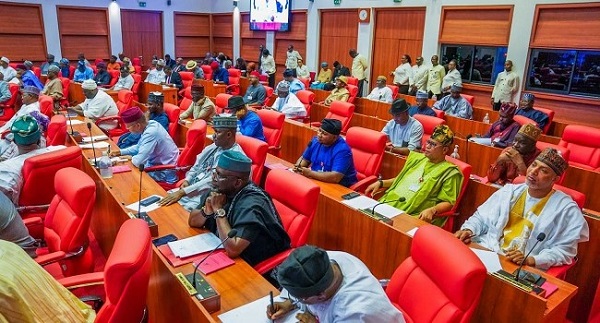
Former Chief Whip of the Senate, Distinguished Senator Rowland Owie, KSJI and chieftain of the Action Democratic Congress (ADC), has strongly condemned the decision of the Nigerian Senate to reject the proposal for mandatory, real-time electronic transmission of election results, describing it as a grave regression that strikes at the very heart of electoral transparency, credibility, and public confidence in Nigeria’s democratic order.
In a statement personally issued by him on Wednesday, Senator Owie said the Senate’s action amounts to a deliberate weakening of the safeguards required to ensure free, fair, and verifiable elections.
His condemnation follows the Senate’s rejection of an amendment to Clause 70(3) of the Electoral Amendment Bill, which sought to make the electronic transmission of election results compulsory. While the Senate President clarified that the chamber merely retained the existing provision of the Electoral Act allowing results to be transmitted “in a manner as prescribed by the Commission”, Senator Owie stated that this position preserves dangerous ambiguity and undermines public scrutiny.
The statement read in part:
“I condemn, in the strongest and most unequivocal terms, the decision of the Nigerian Senate to reject the mandatory, real-time electronic transmission of election results.
This decision represents a profound setback for electoral reform and an unfortunate capitulation to opacity at a moment when Nigeria ought to be consolidating democratic trust.
Across the democratic world, technology is being harnessed to deepen transparency, reduce manipulation, and restore public faith in elections. Regrettably, the Nigerian Senate has chosen a different path; one that protects loopholes, preserves uncertainty, and sustains a system historically prone to dispute, alteration, and abuse.
Real-time electronic transmission of results is neither radical nor partisan; it is a democratic imperative. It curtails human interference, constrains post-poll tampering, and ensures that the sovereign will of the voter, as expressed at the polling unit, is faithfully and transparently reflected in the final declaration of results.
To reject this safeguard and retreat to the vague provisions of the 2022 framework is to signal an unwillingness to subject our elections to full public scrutiny. Such a posture raises serious and unsettling questions about the commitment of the political establishment to credible, free, and fair elections in 2027.”
Senator Owie emphasised that Nigerians are entitled to an electoral system that commands confidence and reflects contemporary democratic standards.
The statement further read:
“The pattern is now unmistakable: reforms that entrench transparency are resisted, while ambiguities that favour incumbency are carefully preserved. This is neither accidental nor benign.
Democracy is not static; it must evolve in step with time, technology, and the legitimate expectations of the people. Elections must be decided by voters, openly, promptly, and verifiably; not by delays, discretionary procedures, or backroom revisions.
I therefore call on Nigerians, civil society organisations, the media, and the international democratic community to take sober note of this regression and to remain steadfast in demanding an electoral framework that meets modern democratic norms.
Nigeria deserves elections that are transparent, verifiable, and beyond manipulation. Anything less constitutes an injustice to the electorate and a betrayal of the democratic promise.”
The former Chief Whip reaffirmed his long-standing commitment to electoral integrity and democratic reform, noting that the credibility of Nigeria’s elections is inseparable from the legitimacy and stability of its constitutional order.