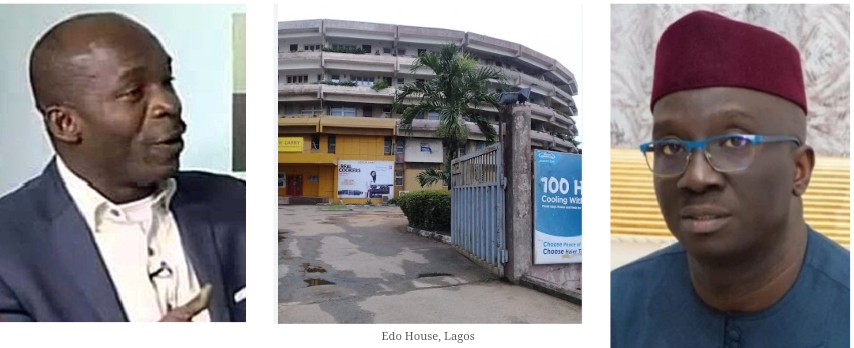
Concerns are mounting across Edo State following reports suggesting that the government may be considering the sale, concession, or transfer of Edo House, located at 1225 Ahmadu Bello Way, Victoria Island, Lagos.
The development has triggered widespread reactions from citizens both within Nigeria and in the diaspora, with many describing the property as one of the most valuable and symbolically important assets owned by the state outside its borders.
Public anxiety has further intensified following appeals from respected figures, including former Senator Ehigie Uzamere, who urged the state government to reconsider any decision that could permanently remove the property from public ownership.
In a detailed intervention, concerned stakeholders argue that Edo House is far more than a physical structure or commercial asset. They describe it as a historic inheritance representing continuity, institutional identity, and long-term public wealth belonging to present and future generations of Edo people.
Located in the heart of Victoria Island, one of Nigeria’s most valuable commercial hubs, the property is widely regarded as a prime asset with significant economic potential. Estimates have placed its value in the range of hundreds of millions to nearly a billion dollars, depending on market conditions and valuation methods.
Critics of any proposed sale argue that disposing of such an asset would amount to sacrificing long-term financial stability for short-term gains. They maintain that in a challenging economic environment, governments should be seeking ways to maximize and sustain revenue-generating assets rather than liquidating them.
According to the position expressed by stakeholders, Edo House could be transformed into a major revenue-generating hub if properly managed. Suggested uses include a commercial leasing centre, hospitality and business complex, investment and technology hub, or a structured institutional facility capable of generating consistent income for the state.
Beyond its financial value, the property is also viewed as a symbol of Edo State’s historical presence and institutional legacy, inherited from the Bendel State era. Many argue that once such strategic public assets are sold, they are rarely recovered, regardless of future political administrations.
The growing public reaction also reflects broader concerns about transparency in government asset management across the country. Citizens are calling for full disclosure, legislative oversight, and open consultation before any decision is made regarding the property.
Stakeholders insist that if redevelopment or modernization is necessary, it should be carried out transparently, with ownership remaining firmly in the hands of the Edo people.
They further emphasize that leadership is not only defined by new projects initiated but also by valuable public assets preserved for future generations. In their view, Edo House represents a heritage that should be protected, not privatized.
As discussions continue, many have urged the state government to formally clarify its position and reassure the public that no irreversible decision will be taken without proper accountability and public engagement.
For now, Edo House remains at the centre of a growing debate on governance, heritage, and the long-term economic direction of Edo State.