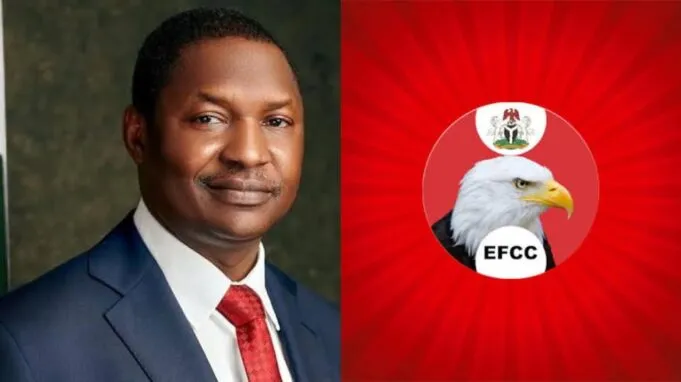
The Economic and Financial Crimes Commission (EFCC) has filed a 16-count money laundering charge against the immediate past Attorney-General of the Federation and Minister of Justice, Abubakar Malami (SAN), his son Abdulaziz Malami, and an employee of Rahamaniyya Properties Limited, Hajia Bashir Asabe.
According to the charges dated December 23, 2025, the trio allegedly laundered about N9 billion to acquire luxury properties in Abuja, Kebbi, Kano, and other locations. Malami is expected to account for roughly 30 houses valued at N212.8 billion, most of which were reportedly purchased during his eight-year tenure as AGF from 2015 to 2023 under the late President Muhammadu Buhari’s administration.
The charge sheet details multiple alleged schemes to conceal illicit funds. Between July 2022 and June 2025, Malami and his son allegedly used Metropolitan Auto Tech Limited to hide over N1 billion in a Sterling Bank account. Other alleged transactions include:
-
Between September 2020 and February 2021, laundering over N600 million through the same company.
-
Retaining N600 million in March 2021 as cash collateral for a loan to Rayhaan Hotels Ltd, despite knowing it was from unlawful sources.
-
Using Rahamaniyya Properties Limited in November 2022 to conceal N500 million paid for a luxury duplex at Amazon Street, Maitama, Abuja.
-
Disguising and controlling billions through Meethaq Hotels Ltd accounts from 2022 to 2025.
-
Multiple concealed property payments between 2015 and 2022 across Abuja, Kebbi, and Kano, including addresses such as Onitsha Crescent, Jabi District, Asokoro District, Rhine Street, and Efab Estate.
Malami remains in EFCC custody and has not made an official statement. He previously requested the recusal of EFCC Chairman Ola Olukoyede from the trial.
The prosecution team is led by Chief Jibrin Okutepa (SAN) and Ekene Iheanacho (SAN), with support from 14 other lawyers and ten pre-listed witnesses. The Federal High Court in Abuja has yet to set a trial date.
The EFCC may also use the Non-Conviction Asset Forfeiture clause to seize some properties, allowing interested parties 14 days to contest the action.
This case is one of the most high-profile money laundering prosecutions in Nigeria in recent years, bringing intense scrutiny to alleged large-scale property acquisitions and the concealment of illicit funds by a former top government official and his associates.