The crisis rocking the African Democratic Congress (ADC) is no longer looking like an ordinary internal disagreement. What started as a leadership dispute is now turning into a full political war — one that could seriously affect the party’s chances ahead of the 2027 general election.
At the heart of the drama is one major question: who is the real national leadership of the ADC?
Right now, two rival camps are holding tightly to different interpretations of the law, different readings of court rulings, and different claims to legitimacy. And as both sides continue to speak with confidence, the bigger fear is that the party may be burning precious time while 2027 keeps drawing closer.
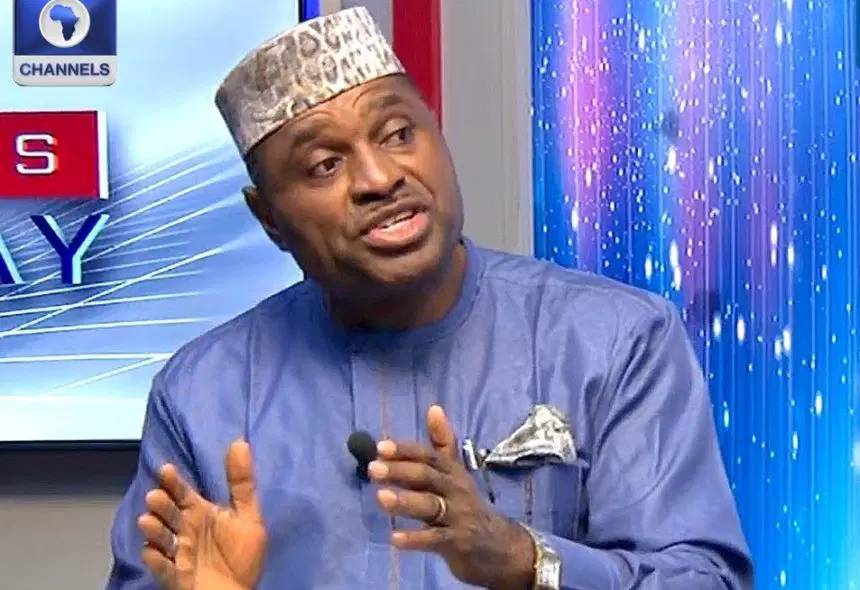
One of the strongest voices from the camp backing former Senate President David Mark is lawyer and party chieftain Kenneth Okonkwo, who says what is happening is not just a disagreement but a deliberate attempt to weaken the ADC from within — or even from outside.
To him, the whole controversy is suspicious.
Okonkwo argued that it makes little sense for someone he claims had already resigned from the party to suddenly return and challenge its leadership in court. In his view, the current leadership structure already has legal and institutional backing because INEC had recognised it.
And for him, that recognition matters a lot.
According to Okonkwo, once INEC has officially acknowledged a leadership arrangement, it cannot simply be reversed through what he describes as a temporary legal move. He insists that the court’s directive to maintain the “status quo” should be understood as preserving the current recognised leadership, not rolling the party back to an earlier arrangement.
In simple terms, his camp is saying: “INEC has already recognised us, and the court order does not remove that.”
He also warned that the pressure being mounted on INEC through repeated letters and public noise could be part of a wider political game. And in his words, if the electoral body eventually changes its position under such pressure, it may fuel suspicions that outside political interests are trying to destabilise the ADC before the next election cycle.
But on the other side, the response has been just as forceful.
The Acting National Publicity Secretary of the ADC, Bashir Abdul-Mohammed, has rejected that entire narrative and insists that what happened was not a lawful transition but an attempted takeover.
To him, this is not a matter of political convenience or public interpretation — it is a matter of party constitution and legal process.
He argued that the ADC constitution is very clear: if a national chairman resigns, the deputy national chairman should automatically step in. Based on that argument, he says Nafiu Bala remains the rightful acting chairman of the party.
And that is where the matter gets even more serious.
Abdul-Mohammed insists that the phrase “status quo ante bellum” — the legal expression at the centre of the dispute — does not mean preserving the current arrangement being celebrated by the David Mark camp. Instead, he says it means returning things to how they were before the dispute even started.
That means, in his own interpretation, the court order should restore Bala’s leadership, not validate the rival camp.
He went even further by accusing INEC of refusing to fully comply with the court’s directive, warning that contempt proceedings could be considered if the commission fails to correct what his faction sees as a wrongful recognition.
And in another dramatic twist, Abdul-Mohammed also dismissed a purported resignation letter linked to Nafiu Bala, describing it as forged and insisting that the matter is already before the court.
So now, what should have been a political disagreement has turned into a messy triangle involving party constitution, legal interpretation, and INEC’s role.
And honestly, this is where the real danger lies.
Because while the two camps continue to fight over who controls the ADC today, Nigerians watching from the outside are already asking a harder question: Can a party struggling to manage itself really convince the country it is ready to lead in 2027?
That is the bigger political damage this crisis is causing.
Every day this fight continues, the ADC risks looking less like a serious alternative and more like another opposition party trapped in the same old Nigerian pattern — court cases, factional camps, conflicting press statements, and public embarrassment.
For now, both sides say they are standing on law, due process, and legitimacy.
But until the courts give a clearer final direction — and until the party settles who truly holds the steering wheel — the ADC may remain stuck in confusion at the exact time it should be preparing for relevance.
And in politics, confusion is costly. Especially when 2027 is already on the horizon.