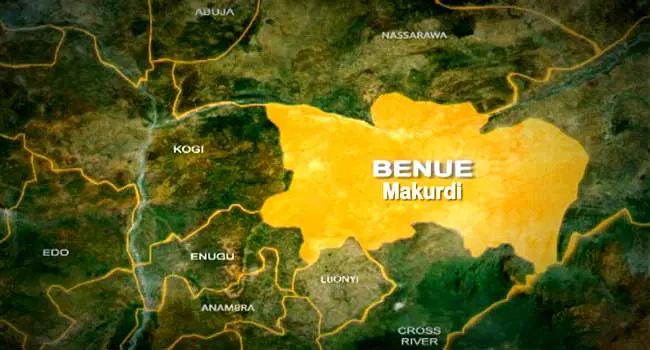
A drive through parts of Benue State today no longer feels like a journey through farming communities. It feels like a slow passage through fear, loss and unanswered questions.
From Anyiin to Ayilamo in Logo Local Government Area, the signs are everywhere. Abandoned homes. Compounds swallowed by weeds. Quiet roads where life once moved with purpose. Entire communities that used to be full of farmers, families and children have now fallen silent — not because people willingly left, but because they were forced to run.
And what they left behind is not just land.
They left behind homes, livelihoods, memories, food sources and ancestral roots.
For months now, residents say repeated attacks by suspected armed herdsmen have pushed people out of several communities along the Anyiin–Ayilamo axis, leaving once-thriving settlements largely deserted. But what is making the pain even harder to process for many locals is what they say is happening after the people flee.
According to residents and local voices, while farmers can no longer return safely to their own land, mining activities are reportedly continuing in many of the same deserted areas.
That is where the outrage is growing.
Because to the people affected, this no longer looks like random violence alone. It is beginning to look like a pattern — one that is forcing locals off their land while others continue to operate there without disruption.
That suspicion is what now hangs heavily over communities in both Logo and Kwande local government areas.
One resident, who spoke anonymously, described the situation in painful terms. He said anyone travelling from Anyiin toward Ayilamo would immediately notice how communities from Tsukwa to Akwana and even areas close to Ayilamo town have been emptied out by repeated attacks. These are not just isolated compounds, he said. These are whole communities where people once farmed yam, cassava, maize and other crops that fed households and supported the local economy.
Now, those farms are lying untouched.
And for many displaced families, that means more than economic loss. It means survival itself has been interrupted.
Because in places like these, farmland is not just property. It is food, income, school fees, dignity and continuity.
Yet even as residents remain too afraid to return, locals say miners are still moving freely in some of these same areas. And that contradiction is what has become deeply difficult for many people to ignore.
One of the strongest concerns being raised is this: why are the villagers under attack, but the miners are not?
Residents say they have repeatedly heard of attacks on farmers and indigenous landowners, but not of similar violence directed at mining operators. That contrast has become one of the most emotionally charged aspects of this crisis.
To many displaced people, it raises a painful possibility — that the violence may not just be about open grazing or territorial clashes, but could also be entangled with control of mineral-rich land.
That concern was echoed by Joseph Apegh, a media practitioner from Logo LGA, who said communities such as Mbagber, Tombo, Ukemberagya/Tswarev and Ayilamo are all witnessing active artisanal mining even as local people remain displaced.
According to him, what should have been a blessing in the form of natural resources has instead become a source of fear and devastation for the people who own the land.
He said minerals such as lithium, fluorite, iron ore, gemstones and limestone are being mined in the area, even while residents are unable to safely return to their communities.
That is a deeply painful contradiction.
Because when communities rich in resources become unsafe for their own people, while extraction continues around them, people begin to feel not only abandoned — but dispossessed.
And this concern is not limited to Logo alone.
In neighbouring Kwande LGA, particularly in the Turan axis, similar claims are emerging. Lawrence Akerigba, a former adviser to the chairman of Kwande LGA, said several communities hosting mining sites have also been deserted after repeated attacks.
He pointed specifically to mining sites in Mbakyol Council Ward, Inungugh in Yaav Council Ward, and Waya community, where he said foreign miners — including Chinese operators — are still active despite the insecurity that has driven indigenous landowners away.
According to him, the sight of outsiders continuing business in communities that indigenes can no longer safely enter has become one of the most disturbing realities on the ground.
His words reflect the kind of anger and helplessness many locals now feel.
He alleged that many residents strongly suspect some form of collaboration or at least troubling overlap between the violence and the uninterrupted mining activity. That is a serious allegation and one that would require careful, independent investigation. But whether proven or not, the fact that so many locals now believe this tells its own story about the level of trust that has broken down.
And beneath all the speculation is something far more immediate and heartbreaking: people are dying, families are scattering, and entire communities are disappearing.
Akerigba gave a deeply personal account of the scale of the suffering in Turan, saying four of the five wards in the area have effectively been vacated, with many displaced people now crowded into Yaav. Even there, he suggested, people do not feel fully safe.
He recalled recent attacks in Jato Aka, where 13 lives were reportedly lost, and another deadly attack in his own village, Boagungu Mbaav in Mbadura Council Ward, where 10 people — including his elder brother — were reportedly killed after sneaking back to retrieve food.
That detail says everything about the cruelty of displacement.
People are not only being driven out — they are being forced into situations where even trying to get food from their own villages can become a death sentence.
And that is why this crisis cannot be treated as just another rural conflict headline.
This is a humanitarian, security and governance emergency unfolding in plain sight.
The people speaking out are not just asking for sympathy. They are asking for serious federal attention, deeper security intervention, and a transparent investigation into whether there is any connection — direct or indirect — between the continued attacks and the ongoing mining activity in these abandoned communities.
Because if people are being pushed off mineral-rich land while extraction continues uninterrupted, then what is happening is not just displacement.
It is dispossession under fear.
And if that possibility is even remotely true, then what Benue is facing may be far bigger — and far more dangerous — than many are willing to admit.