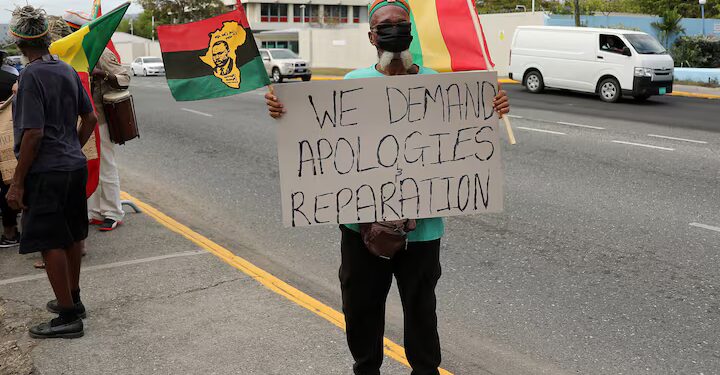

A senior delegation from the Caribbean Community (CARICOM) Reparations Commission has arrived in London this week for discussions with British officials and lawmakers on addressing the enduring harms of slavery and colonialism. The mission, taking place from November 17 to 20, 2025, represents CARICOM’s most coordinated push in years to engage the UK directly.
From the 15th to 19th centuries, over 12.5 million Africans were forcibly trafficked across the Atlantic, with Britain alone transporting more than 3 million to the Caribbean. CARICOM argues that the social, economic, and political legacies of this system continue to shape inequality in the Caribbean, Africa, and the wider diaspora.
The 15-member bloc, which includes Barbados, Jamaica, Trinidad and Tobago, and Guyana, has long advocated for reparatory justice. Its 10-point plan calls for a full and formal apology, debt cancellation, education reforms, public health initiatives, and financial compensation. The African Union is pursuing a similar framework.
While reparations campaigns have gained global attention, political resistance remains strong. Some European leaders, including UK officials, argue that present-day governments should not be held liable for historic crimes, warning that reparations could spark complex legal and financial claims. Despite these challenges, the 2024 Commonwealth summit in Samoa marked a shift, with leaders acknowledging the need for discussion on reparations—a first at this level.
CARICOM’s London visit aims to strengthen strategic partnerships and promote public education on the reparations agenda. Delegates are scheduled to meet MPs, civil society groups, historians, and advocacy organisations. A 2025 poll by The Repair Campaign revealed that 85% of Britons were unaware that the UK forcibly transported over 3 million Africans to the Caribbean, highlighting the need for education as part of reparatory efforts.
Caribbean governments emphasise that the demand for reparations is not about assigning personal blame, but about recognising historical injustices and addressing their ongoing socio-economic impact. While the outcome of the London meetings remains uncertain, the visit represents a new phase in CARICOM’s long-standing quest for justice.