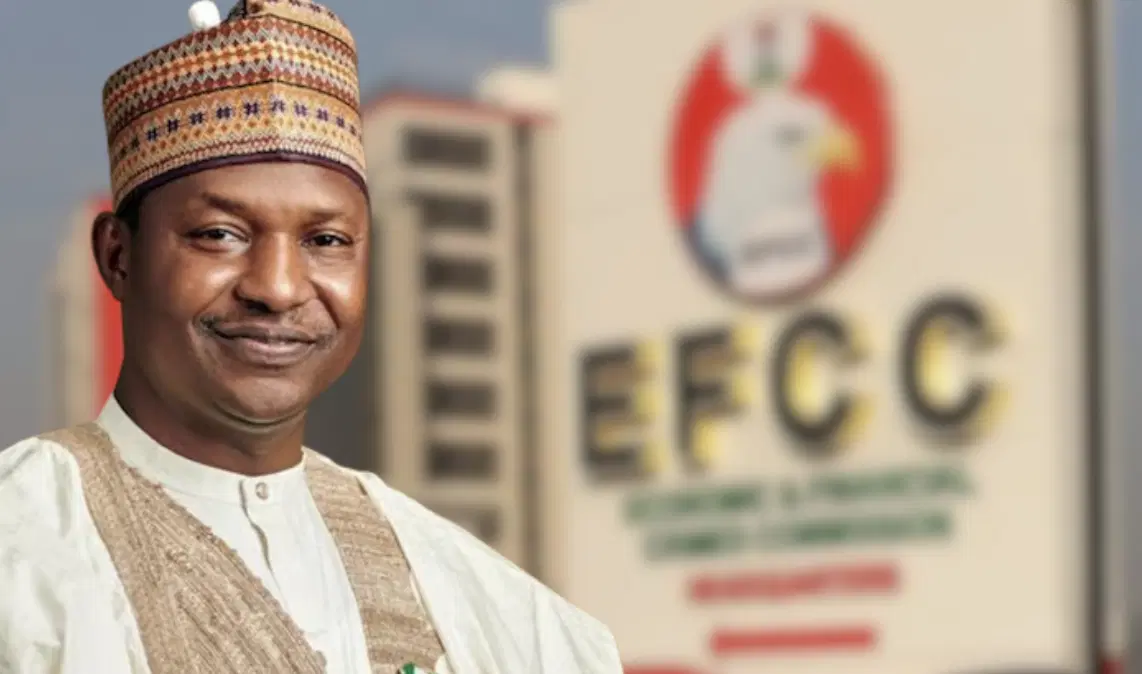
Fresh legal trouble don land for former Attorney-General of the Federation, Abubakar Malami, as the Economic and Financial Crimes Commission (EFCC) has asked the Federal High Court in Abuja to permanently seize 57 properties it says are tied to him and suspected to be proceeds of unlawful activities.
According to the anti-graft agency, the properties, spread across Abuja, Kebbi, Kano, and Kaduna, are far beyond what Malami could have legitimately acquired from his known earnings while serving in government. The EFCC is now pushing for the assets to be officially handed over to the Federal Government.
The commission, through its legal team led by senior lawyers, told the court that the respondents in the case failed to provide enough evidence to overturn the earlier interim forfeiture order already granted by the court. In simple terms, EFCC is saying: we have shown enough reasons to hold these properties, and those involved have not convincingly explained otherwise.
The suit, marked FHC/ABJ/CS/20/2026, lists Malami alongside several individuals and companies allegedly connected to the assets. Among them are Hajia Bashir Asabe, Abiru’ Rahman Abubakar Malami, Rayhaan Bustan, and a number of firms including Agro Allied Ltd, Mountain View Gold and Jewellery Ltd, and Meethaq Hotels Ltd.
EFCC said it is relying on the Advance Fee Fraud and Other Fraud-Related Offences Act, 2006, which allows the court to order forfeiture of properties reasonably suspected to have been acquired through illegal means — even where there has not yet been a criminal conviction. That’s what is known as a non-conviction-based forfeiture.
One major point EFCC is leaning on is the financial mismatch between Malami’s official earnings and the value of the properties under investigation. According to an affidavit filed by one of its investigators, Malami reportedly earned a total salary of N89.6 million between 2015 and 2023, alongside a severance package of N12.1 million and travel allowances amounting to N253.6 million.
But the commission believes those figures do not align with the scale of the real estate and other assets allegedly linked to him. In EFCC’s view, the wealth trail raises serious questions that have not yet been properly answered.
Investigators said they carried out a wide range of checks before approaching the court. These included inquiries with the Corporate Affairs Commission, Federal Inland Revenue Service, Code of Conduct Bureau, Abuja Geographical Information System, and multiple land registries. They also reportedly visited sites physically, assessed the properties, and interviewed relevant persons connected to the matter.
The agency further alleged that some of the properties were not purchased directly in Malami’s name, but rather through third parties and companies believed to be under his influence or control. One of the names that repeatedly surfaced in the filing was the Rayhaan Group, which the EFCC appears to be treating as central to the asset ownership structure.
Even more damaging is the claim that several of the buildings in Kano and Kebbi allegedly do not have proper building approvals. To investigators, that may suggest an attempt not just to acquire assets quietly, but also to keep them away from proper regulatory scrutiny.
The case has already moved through a few legal twists. An interim forfeiture order was first granted in January by a sister court, with instructions that the order be published in a national newspaper to allow anyone with interest in the assets to come forward within 14 days. That publication was reportedly made in THISDAY on January 9, 2026.
Since then, the matter has changed hands in court after one judge recused himself, and it is now before Justice Joyce Abdulmalik, who has fixed April 21 for hearing.
On the other side, Malami and the other respondents are not folding their arms. They have already challenged the case and are seeking to set aside the interim forfeiture order, meaning this legal battle is still very much alive.
At the centre of everything is a familiar Nigerian question: can public office explain private wealth? That is what this case may ultimately test. If EFCC succeeds, it would be one of the more significant asset forfeiture cases involving a former top government official in recent times.