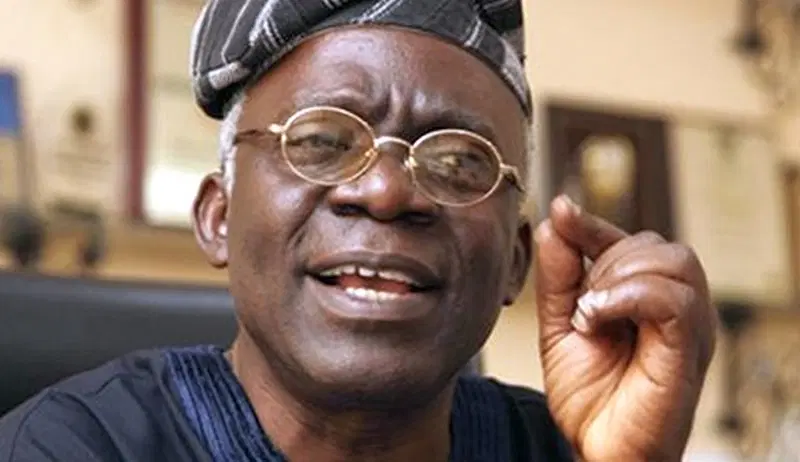
Human rights lawyer and Senior Advocate of Nigeria, Femi Falana, has weighed in on President Bola Tinubu’s decision to deploy Nigerian troops for a peace mission in Benin Republic, warning that military intervention alone cannot stop coups in West Africa if democracy continues to fail at home.
Speaking in an interview aired on Channels TV’s Politics Today, Falana examined the legal, political, and moral dimensions of the Senate-approved deployment. While acknowledging that the Constitution allows the president to seek Senate consent before engaging in external military action, he said deeper issues must be confronted if Nigeria truly wants to stabilise the region.
Falana explained that the intervention is being justified under ECOWAS protocols on democracy and good governance. However, he noted that Nigerian law also requires the National Assembly’s approval before any international agreement can take effect locally. Beyond legality, he argued that the bigger question is whether peace can exist without justice.
According to him, the wave of coups across West Africa did not happen by accident. He pointed to fragile democratic systems, exclusion of opposition voices, and shrinking political space as the real triggers. Falana cited countries like Benin Republic, where opposition figures are reportedly jailed, exiled, or silenced, warning that such environments naturally breed instability.
He stressed that Nigeria must first put its own democratic house in order if it hopes to lead regional stability efforts. “You cannot stop coups while turning your country into a one-party state,” he warned, adding that political pluralism and credible elections are non-negotiable.
Falana also highlighted troubling trends across the region. From prolonged rule and constitutional manipulation in Togo and Côte d’Ivoire to military takeovers in Mali, Burkina Faso, Niger, and Guinea-Bissau, he said Africa is paying the price for leaders who undermine democracy. In his view, coups thrive where opposition is crushed and citizens feel shut out of governance.
Responding to concerns about whether the coup attempt in Benin Republic might be the last, Falana was blunt. He said instability would persist as long as opposition leaders are imprisoned, forced into exile, or eliminated. Political repression, he argued, guarantees unrest.
He acknowledged Nigeria’s historic role in restoring democracy in countries like Liberia, Sierra Leone, and The Gambia, but warned that current conditions are different. Where citizens pour into the streets to support military takeovers, external intervention becomes almost impossible.
Falana concluded that preventing coups requires more than soldiers. Governments must tackle poverty, insecurity, illiteracy, and economic hardship. They must also protect freedom of expression, stop criminalising dissent, and allow the Independent National Electoral Commission to open the political space to ideologically driven parties.
“If we want stability,” he said in essence, “we must stop creating the conditions that invite military opportunists.”