
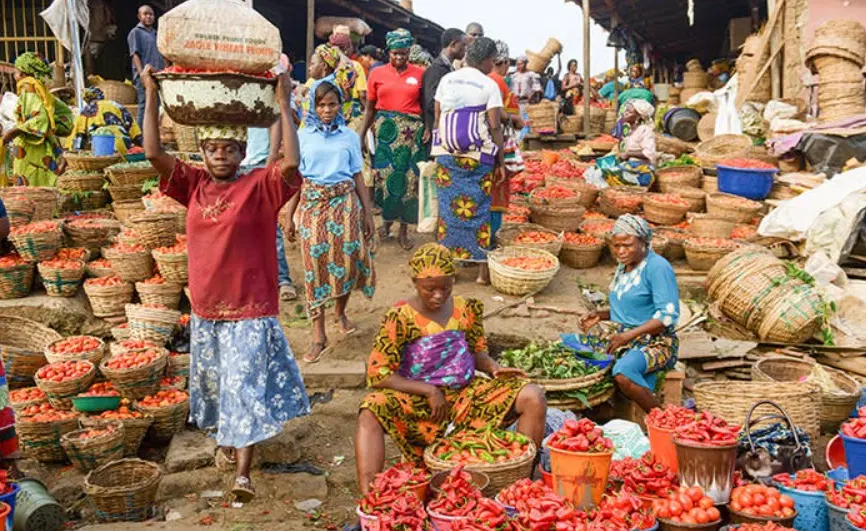

Rising food prices, fueled by increased demand ahead of year-end festivities and lingering insecurity in key food-producing areas, emerged as the main source of inflationary pressure in November 2025. This pushed Nigeria’s month-on-month (MoM) headline inflation rate to 1.22 per cent — its highest level in four months — with analysts warning that a similar trend could play out in December.
Data released by the National Bureau of Statistics (NBS) in its latest Consumer Price Index (CPI) report, however, showed a brighter picture on an annual basis. Headline inflation declined for the eighth consecutive month, easing to 14.45 per cent in November from 16.05 per cent in October.
According to the NBS, the CPI rose to 130.5 points in November, reflecting a higher monthly increase in average prices compared to October. While the year-on-year decline was partly driven by base effects, it still signals a gradual easing of inflationary pressures across the economy.
Food inflation followed a similar pattern. On a month-on-month basis, food inflation rose to 1.13 per cent — the highest in three months — driven by higher prices of staples such as tomatoes, cassava, eggs, pepper, onions, crayfish and melon. On a year-on-year basis, food inflation dropped sharply to 11.08 per cent from 39.93 per cent recorded in November 2024.
Core inflation, which excludes food and energy, also moderated. It declined to 18.04 per cent year-on-year, while month-on-month core inflation eased to 1.28 per cent from 1.42 per cent in October, pointing to some stability outside food-related pressures.
The report highlighted wide inflation disparities across states. Rivers, Ogun and Ekiti recorded the highest year-on-year inflation rates, while Plateau, Kebbi and Katsina posted the lowest. On a monthly basis, Bayelsa, Gombe and Edo saw sharp increases, while Plateau, Delta and Kaduna recorded declines.
Economists say festive spending patterns are largely responsible for the November uptick. United Capital’s Chief Economist, Ayo Akinwunmi, linked the rise to insecurity affecting food supply and higher transport costs, adding that prices are likely to rise further in December before moderating in early 2026.
FBNQuest’s Tunde Abioye echoed this view, noting that year-end celebrations typically trigger temporary food price spikes. Analysts also warned that while annual inflation is trending downward, month-on-month figures remain sensitive to logistics, storage challenges and seasonal demand.
Reacting to the data, the Presidency said President Bola Tinubu’s economic reforms have helped Nigeria beat its 2025 inflation target. In a post on X, the President’s Special Adviser on Policy Communication, Daniel Bwala, said the drop in headline inflation to 14.45 per cent validated the administration’s “tough and disciplined” economic management.
While the easing annual figures offer relief, analysts agree that sustaining the gains will depend on improved security in food-producing regions and stronger supply-side reforms to cushion seasonal price shocks going forward.