Fresh findings have revealed that the Federal Government paid Gombe State N1.2 billion as compensation for the takeover of its NYSC orientation camp, which was converted into a rehabilitation centre for “repentant” Boko Haram fighters under Operation Safe Corridor.
The payment raises fresh questions about Nigeria’s counter-insurgency priorities, especially at a time when many communities in the North-East continue to suffer deadly attacks, bombings and mass displacement.
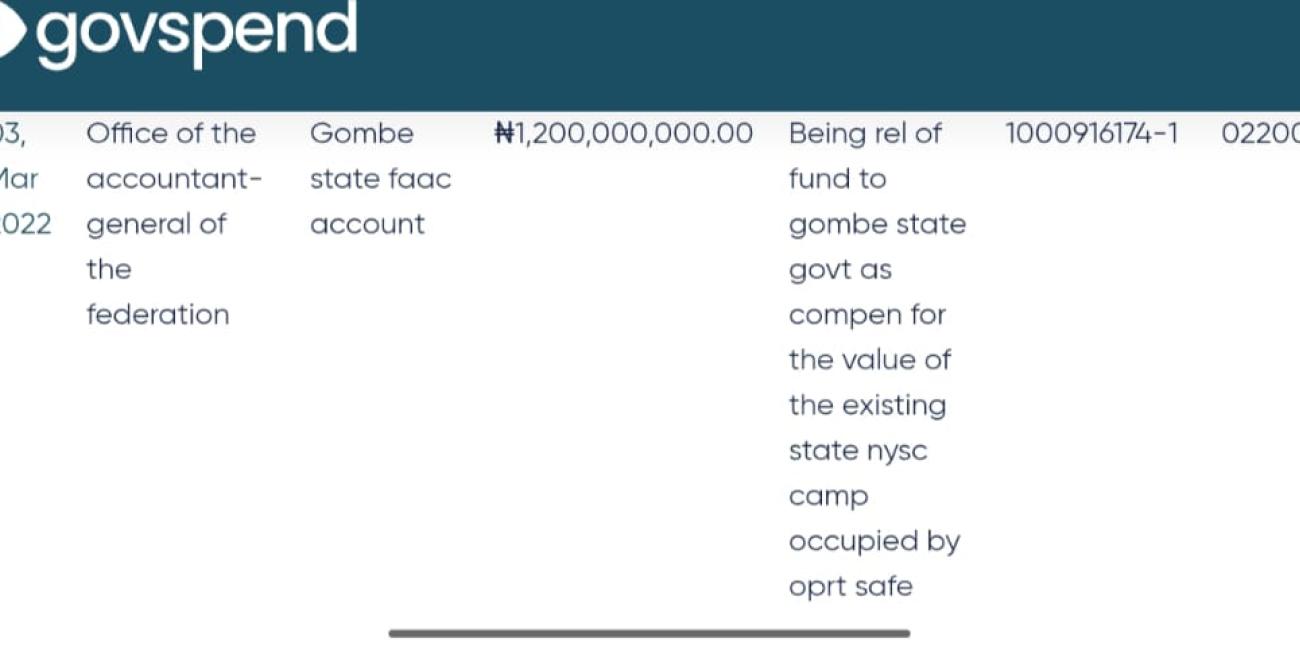
Official payment records show that the N1,200,000,000 was released on March 3, 2022, through the Office of the Accountant-General of the Federation, and paid directly into the Gombe State FAAC account.
The transaction was described as compensation for the value of the existing Gombe State NYSC camp, which had been occupied and repurposed for the Federal Government’s deradicalisation, rehabilitation and reintegration programme for former Boko Haram members.
According to the payment details, the fund release was tied to Administrative Authority (AIE No. A01-00007803), confirming that the takeover of the facility and the financial compensation were formally approved by the Federal Government.
Operation Safe Corridor was created as a state-backed initiative to “deradicalise, rehabilitate and reintegrate” ex-insurgents who surrendered or were captured during military operations.
However, the programme has remained highly controversial, with many Nigerians repeatedly questioning why billions are being spent on rehabilitating former terrorists while victims of insurgency, widows, displaced persons, and grieving communities continue to struggle for support and justice.
That concern becomes even more intense when viewed alongside fresh spending figures from Borno State, where insurgent violence has continued despite massive allocations for the reintegration of ex-fighters.
A review of Borno’s budget performance records shows that the state spent about N7.7 billion over a 21-month period on programmes linked to the rehabilitation and reintegration of “repentant” Boko Haram members.
Out of that figure, about N4.3 billion was spent in 2025 alone under the category of “livelihood support for Repentant Boko Haram members.”
More strikingly, records indicate that N1.6 billion of that amount was released between October and December 2025, showing a sharp increase in spending within just three months.
That figure comes on top of an earlier N3.45 billion reportedly spent between January and September 2024 under the Disarmament, Demobilisation and Reintegration (DDR) programme.
Taken together, the records suggest that while billions have gone into reintegration efforts for ex-fighters, the broader security situation in Borno has remained dangerously unstable.
In fact, the contradiction became painfully clear on the evening of March 16, 2026, when Maiduguri was rocked by a wave of deadly suicide bomb attacks.
The city descended into panic after three suicide bombers detonated improvised explosive devices (IEDs) at different locations, including the Monday Market, the Post Office Flyover, and an area near the University of Maiduguri Teaching Hospital gate.
Eyewitnesses described scenes of confusion and terror as explosions tore through crowded public spaces, sending residents and traders running for safety.
By the time emergency responders arrived, the damage had already been done.
A total of 23 people were confirmed dead, while 108 others sustained injuries, some of them severe and life-threatening.
Hospitals across Maiduguri were reportedly overwhelmed as doctors and medical workers battled through the night to treat victims.
The Borno State Police Command later confirmed the casualty figures and said investigations had begun into the attacks and those responsible.
The development has once again reignited the national debate over the logic of spending huge public funds on former insurgents while terrorism continues to claim innocent lives.