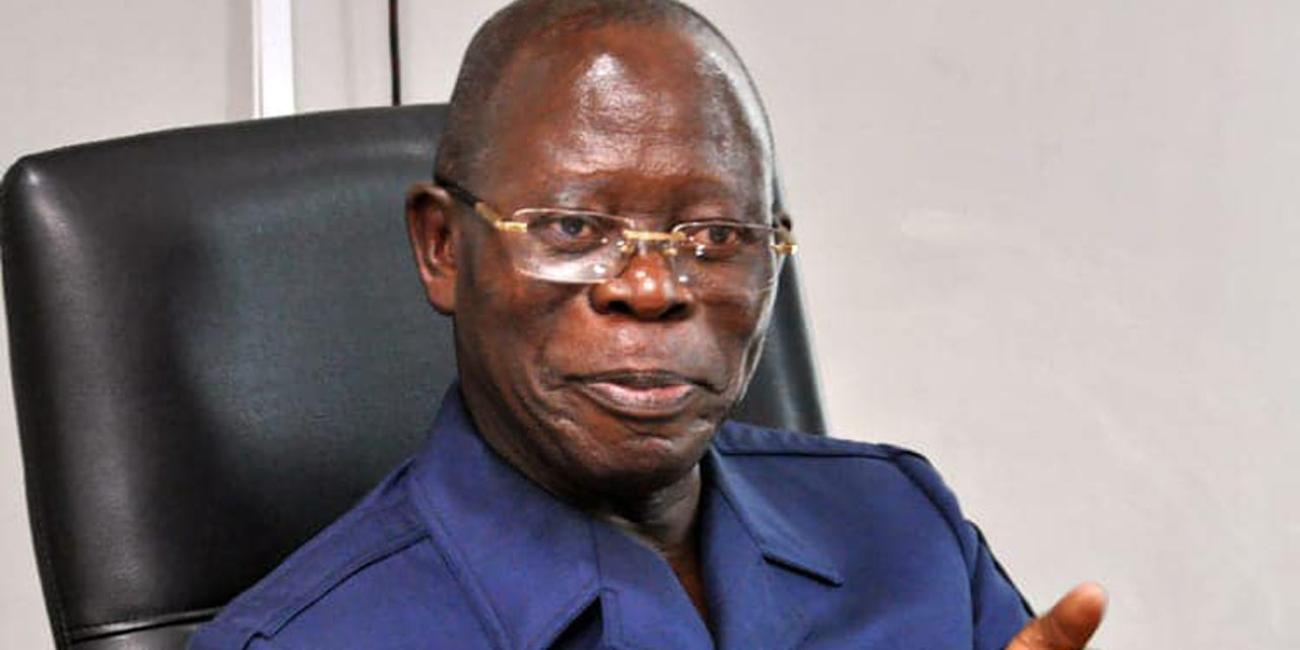

Fresh revelations from the family of late labour legend, Pa Michael Imoudu, have reopened painful questions about how Nigeria treats its heroes, particularly the role allegedly played by former Nigeria Labour Congress (NLC) president and ex-Edo State Governor, Adams Oshiomhole, in what the family describes as a humiliating neglect of the nation’s foremost labour leader, even in death.
The allegations were made public by Pa Imoudu’s daughter, Dr. Veronica Imoudu-Omosun, during the 20th posthumous anniversary of the labour icon held on December 20, 2025, in Lagos. Speaking emotionally, she recalled how her father, celebrated as “labour leader number one” and credited with leading Nigeria’s first-ever general strike, was allegedly abandoned by the very movement he gave his life to serve.
According to her, a tripartite burial committee involving the Imoudu family, the NLC, and the Edo State Government was constituted after Pa Imoudu’s death in 2005. While Edo State reportedly released funds, she claimed none of the money reached the family. She further revealed that although the NLC launched an Imoudu Burial Appeal Fund with contributions from affiliate unions, organisations, and individuals, the family never received the expected burial support.
As burial plans stalled, the family reportedly sent the eldest son, Dr. Wilfred Imoudu, to personally meet Adams Oshiomhole. What followed, according to Dr. Imoudu-Omosun, was a moment that has remained deeply painful for the family. Oshiomhole allegedly dismissed the request, asking bluntly, “Can’t you bury your father?” Dr. Wilfred reportedly replied that the family would bury their father “in our own way.”
Beyond funding, the family also accused Oshiomhole of frustrating plans for a lying-in-state in Lagos, where Pa Imoudu spent much of his life and where thousands of workers were expected to pay their last respects. Arrangements had reportedly been made to fly his remains from Benin to Lagos and back the same day, with the Nigerian Air Force Base in Benin agreeing to handle the return flight at a modest cost.
The NLC had written to then Lagos State Governor, Bola Tinubu, requesting support. Lagos State provided Rowe Park, Yaba, approved a half-day holiday for workers, and made financial donations—₦1 million to the NLC Lagos Council and ₦2 million to the NLC National Headquarters. However, Dr. Imoudu-Omosun alleged that despite repeated pleas, Oshiomhole refused to release part of the ₦2 million to fund the flight, leading to the cancellation of the lying-in-state.
She painted a sobering picture of her father’s life, noting that despite his fame and decades of sacrifice for workers from the 1940s until his death in 2005, Pa Imoudu lived and died a poor man. He reportedly never had enough money to build a personal house and was once evicted from the modest home known as “Imoudu House,” until Chief Obafemi Awolowo intervened to secure him some comfort late in life.
While expressing gratitude that the 20th anniversary memorial was finally held in Lagos, Dr. Imoudu-Omosun noted that it was now being organised jointly by the family and what she described as a “more responsive NLC leadership,” a sharp contrast to what they experienced two decades ago.
For labour historians, activists, and ordinary Nigerians, the revelations raise uncomfortable questions about legacy, gratitude, and leadership. At the heart of it all lingers a haunting question that continues to trouble many: how did the family of Nigeria’s greatest labour icon come to be asked, “Can’t you bury your father?”