
This content has been archived. It may no longer be relevant
Sixty years after the January 15, 1966 aborted military coup, eminent Nigerians have reflected on the incident, describing it as a turning point that fundamentally altered Nigeria’s socio-economic and political trajectory. They called for an urgent return to fiscal responsibility and true federalism as the only viable path to national stability and progress.
The reflections were shared in Lagos during the launch of The Gun Hegemony, a new book by Chief Ayo Opadokun, Secretary of the National Democratic Coalition (NADECO). Among the elder statesmen who spoke were former Commonwealth Secretary-General, Chief Emeka Anyaoku; Chairman and Publisher of Vanguard Newspapers, Uncle Sam Amuka; Catholic Bishop of Sokoto Diocese, Bishop Matthew Hassan Kukah; and several democracy activists.
Speakers agreed that prolonged military intervention in governance distorted Nigeria’s federal structure, weakened institutions, and entrenched centralised power at the expense of regional development.
Chairing the event, Uncle Sam Amuka argued that Nigeria cannot genuinely function as a federation if its political system does not reflect federal realities. He noted that military rule introduced “gun hegemony,” a culture of coercion that reshaped governance and civic life. According to him, Nigeria urgently needs a new constitution that reflects its diversity and federal character.
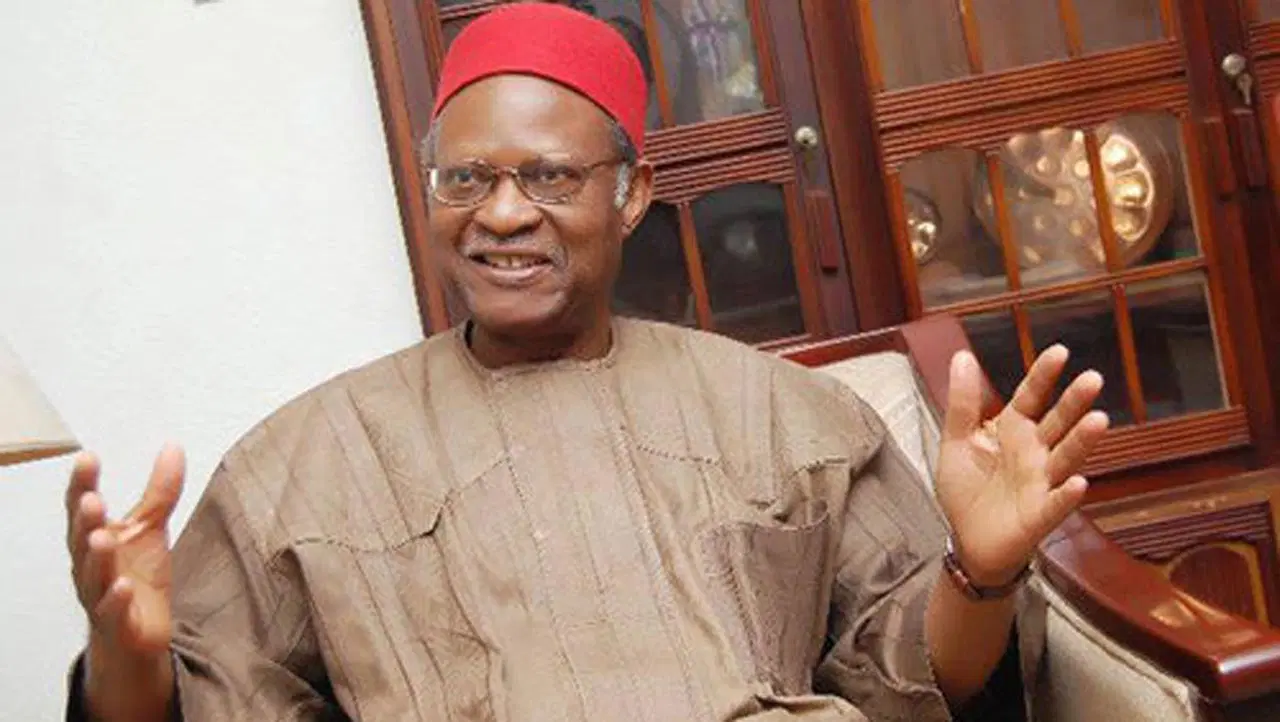
Chief Emeka Anyaoku expanded on this view, stressing that pluralistic nations only thrive when governed by constitutions that respect their diversity. Drawing comparisons with India, Canada and Switzerland, he argued that Nigeria’s failure to operate true federalism has stalled development. He recalled how regional governments before military intervention used local resources—cocoa, groundnut, palm produce and rubber—to drive development and innovation.
Anyaoku warned that countries which ignore their pluralistic nature risk stagnation or disintegration, citing Yugoslavia, the former USSR and Sudan as examples. He maintained that Nigeria’s unity can only be sustained through a people-driven, truly federal constitution.
Bishop Kukah, speaking virtually, cautioned against romanticising military rule as a solution to Nigeria’s problems. He insisted that good governance, accountability and justice—not coups—remain the antidote to authoritarianism and instability.
President Bola Tinubu, represented by his Chief of Staff, Femi Gbajabiamila, described The Gun Hegemony as a patriotic contribution rooted in lived experience. Lagos State Governor Babajide Sanwo-Olu, represented by the Attorney-General, Lawal Pedro (SAN), said the book serves as a reminder of the sacrifices made to secure democracy and the need to protect it.
Author Ayo Opadokun, however, argued that Nigeria’s current state cannot be separated from decades of military dominance and its civilian extensions. He revealed that the book presents new historical evidence, including links between the January 1966 coup and figures previously not associated with it. He maintained that military intervention irreversibly altered Nigeria’s developmental path.
The event drew a wide array of political leaders, scholars, activists and traditional figures, reinforcing the consensus that Nigeria’s future depends on restructuring, constitutional reform and a recommitment to democratic federalism.