By Bala Ibrahim.
Once again, it’s another season of holidays and people are on the road to visit home. Although the holiday, as declared by the Government, begins on Wednesday, the 24th of December, traditionally, a lot of people set out early in order to beat the stress of rush hours on the road. Accordingly, the highway is always besieged by an unusual traffic. Since time immemorial, just like the Government keeps a calendar of the days it will declare as public holidays, it is expected it will also keep in view, an idea of the increased quantum of vehicles that will besiege the roads. Proper planning should make those in charge of the roads to envisage the influx, and therefore do the needful, as far as vehicular control is concerned. But for some reasons, those in charge of this task in Nigeria, are always unresponsive here.
Year after year, season after season, or holiday after holiday, road travels in Nigeria are a nightmare. In fact, many a times, they turn into a horror that torments not just the traveller, but even the vehicle in use. Although road gridlock is more like a permanent feature in urban centres around Nigeria, major highways, particularly on routes to Lagos, Abuja, Benin City, and the famous Abuja-Kaduna highway, have made it to the list of the notorious, with regards dangers and the meaning of menace. Almost always, traffic demand is exceeding the road capacity, resulting sometimes, in complete stagnation or blockages across the entire stretch of the road. Worse is during festive seasons like now, where the roads are bumper to bumper with vehicles.
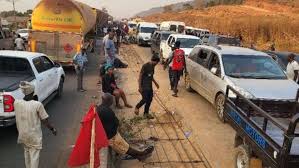
I read and heard recorded voices of stranded travellers along Abuja- Lokoja road today, where movement was, or may be still paralyzed, pursuant to the gridlock that visited the road. Tankers and trailers are literally all over the place, with cars and commuters competing for space to squat. Every where is in a state of confusion and help seems out of sight. Food, water and emergency medication are the major worries of all, including the nearby villagers, whose environment has become a regular host of such horror. The economic losses are severe, while for the travellers and the transporters, the operational costs can only be imagined.
About two days ago, someone travelling from Abuja to Kano told me he had to spend the night in Kaduna, which is half way to his destination. He said they spent between 5 to 6 hours on one spot. This is for a journey that ordinarily shouldn’t exceed 5 hours. Yes, it is understandable for traffic gridlocks to happen when there is infrastructure and maintenance work, but those in charge are expected to be scientific in thinking. As engineers and managers, they know the consequences of such road works are delays in movement, occasioned by the introduced traffic diversions. They are suppose to make adequate and convenient provisions of such temporary measures. But they never do enough. Why?
It is also expected, because they know the road users are Nigerians, and Nigerians are in the habit of keeping poorly maintained vehicles, with high propensity to breakdowns, that those in charge would make room for such eventualities, including the factor of human behaviour. Impatient drivers are the biggest culprits as far as breaking traffic laws are concerned. For some, driving against traffic, and even blocking the road to chat or buy food stuff, falls under their right. And other road users can go to hell.
Indeed Nigerians have become familiar with such patterns, such that consequences like the economic losses, loss of man-hours, increased fuel consumption, and damage to goods, particularly perishable goods, are not given any consideration any more. But the time has arrived, for people to start thinking about health and safety. Doctors always caution us about the increased risk of pollution. And with the menace of insurgency now, there is an additional security risk, which can be the risk of mass kidnapping, God forbid. Drivers and passengers are also vulnerable to robbery, as miscreants often exploit the congestion to commit havocs.
A simple search on the website of the Federal Road Safety Corps (FRSC), spelt out their duties to include making the highways safe by preventing/minimizing accidents, clearing obstructions and educating the public on road use. It also says their core responsibilities are accident prevention through patrols, research, and education.
Now the question to ask is, to what extent is their research? How effective is this research, if year in-year out, the highways are always turned into the house of horror during public holidays? If they are not having a regular handshake with the Ministry of works in particular, then their research is rubbish and the discharge of their duty is defective, I think.