The internal battle inside the Peoples Democratic Party is becoming harder to ignore, and as the party moves closer to its National Convention this Sunday, one thing is now clear — the fight is no longer just about leadership. It is now openly about 2027 and whether the PDP will stand as a real opposition party or quietly bend in the direction of President Bola Tinubu.
At the centre of this latest storm is the camp led by Kabiru Tanimu Turaki, which has made its position known in unmistakable terms: the PDP should not and will not back Tinubu’s re-election bid in 2027.
That statement may sound obvious on the surface. After all, the PDP is supposed to be an opposition party. But in today’s fractured political reality, even that basic expectation has become a source of fierce internal disagreement. And that is exactly why the issue has become one of the deepest cracks inside the party.
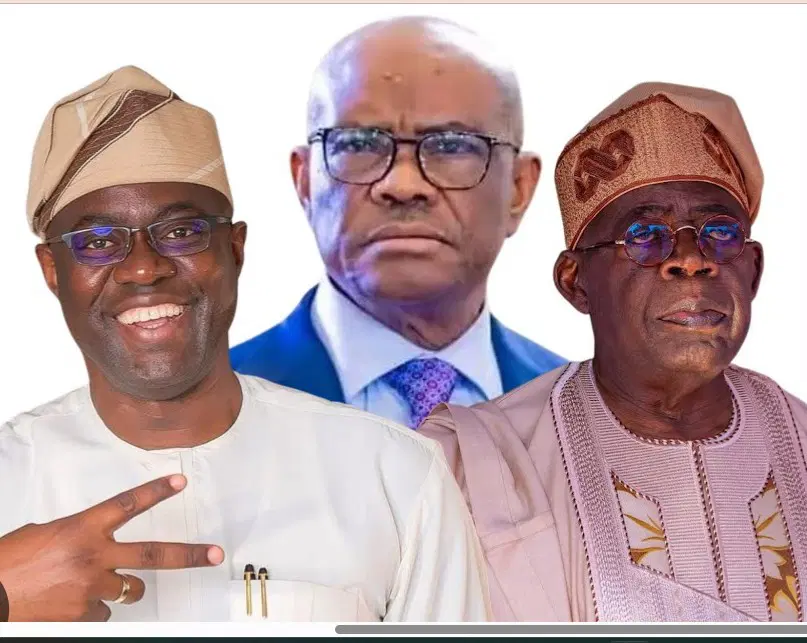
On one side is the camp associated with the Minister of the Federal Capital Territory, Nyesom Wike, which has shown clear sympathy toward Tinubu and appears more open to political accommodation. On the other side is the Turaki bloc, reportedly backed by Oyo State Governor Seyi Makinde, which insists the PDP must remain politically independent and cannot afford to become an extension of the ruling party.
That is the real fight happening here.
Speaking during a live television interview, factional National Publicity Secretary Ini Ememobong said it would be completely wrong for the PDP to endorse the presidential candidate of another party. And frankly, that argument is difficult to dismiss. His point was not just political — it was existential. If an opposition party cannot present its own candidate or defend its own political identity, then what exactly is left of it?
That question now hangs heavily over the PDP.
Still, even amid the tension, there are signs that some of the party’s biggest elders are trying to stop the situation from spiralling beyond repair. Senior figures like Chief Olabode George and former Senate President Bukola Saraki have both made it clear that reconciliation efforts are ongoing and that the party must not be allowed to collapse under the weight of personal ambition and factional pride.
Their message is simple: the PDP may be wounded, but it must not die.
Bode George, in particular, did not hide his frustration. He lamented how personal ambition has pushed the party into a dangerous place and warned strongly against any attempt to drag Nigeria into a one-party political culture. In his view, that would be unhealthy for democracy and a betrayal of the national character the PDP was originally built to represent.
Saraki, on his part, appears to be focusing on what many now see as the most urgent task — keeping the PDP alive enough to remain on the ballot in 2027. His concern is less about public drama and more about political survival. If the convention goes ahead successfully and is properly recognised by INEC, then at least the party still has a structure to build from.
And right now, that alone is no small thing.
Interestingly, even the Wike-aligned camp is also saying the PDP will field a presidential candidate in 2027. That means both camps, despite all their bitterness, are at least publicly saying the party should not disappear from the race. But the real issue is not whether the PDP will produce a candidate — it is whether the party can still agree on what it stands for before it gets there.
That is the deeper crisis.
Because what is happening inside the PDP is not just a disagreement over strategy. It is a battle over identity. Is the party still a genuine national opposition force, or is it slowly becoming a divided political house where personal calculations are beginning to matter more than ideological clarity?
That is why this convention matters far beyond internal party politics.
In Kwara State, party leaders and stakeholders have already said they will attend the Abuja convention, but even there, their language reflects caution. Their position is not built on excitement — it is built on observation. They want to see if the convention is legally recognised, if INEC is present, and if the process gives the party a credible future. In other words, even loyal party members are now watching the PDP like people trying to decide whether the structure is still standing or already collapsing from inside.
And honestly, that says a lot.
The truth is this: if the PDP cannot settle this battle over Tinubu, loyalty, leadership, and political direction, then 2027 may not just be another election cycle for the party — it could become a referendum on whether the PDP still has the strength to exist as a serious national force.
For now, the anti-Tinubu camp has drawn a hard line. The elders are trying to hold the house together. The Wike bloc is moving with its own confidence. And the convention now carries the weight of more than party procedure — it carries the question of whether the PDP can still rescue itself before 2027 fully arrives.