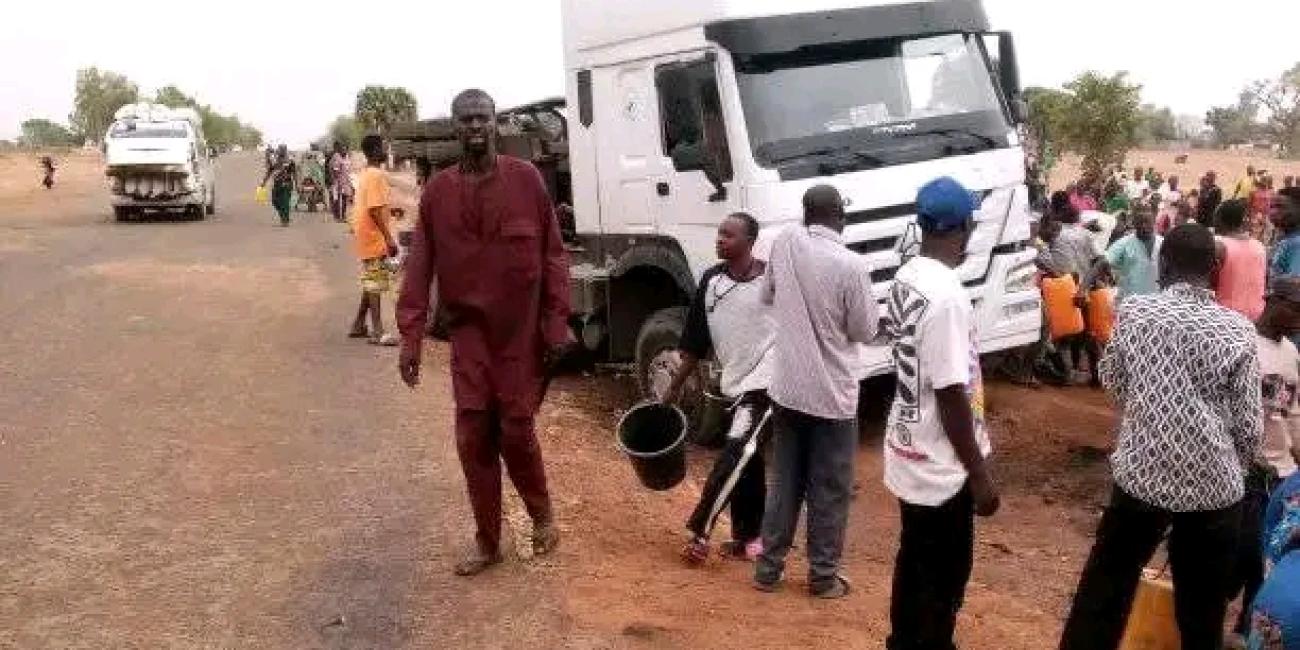
Residents of Kpasam in Adamawa State have once again chosen desperation over danger, rushing to scoop petrol from a fallen tanker despite the very real possibility of a deadly explosion.
The incident happened along the Jalingo–Numan road, a route many road users have repeatedly described as a death trap because of its poor condition and long-standing neglect.
According to eyewitnesses, the tanker, which was carrying highly flammable petroleum products, overturned under unclear circumstances and spilled its contents across the road.
Within minutes, the scene turned chaotic.
Scores of residents, including young men and women, reportedly rushed to the area carrying jerrycans, buckets, bowls, and other containers, all in a frantic effort to collect as much fuel as possible before the situation changed.
What should have been treated as an emergency quickly became a dangerous crowd scene.
Videos and photos circulating online showed people clustering dangerously close to the overturned tanker, ignoring the possibility that even the smallest spark could trigger a devastating fire outbreak.
At the time of the incident, there was no immediate sign of emergency responders or a visible safety cordon to keep residents away from the danger zone.
Sadly, this is no longer shocking in Nigeria.
As fuel prices remain painfully high and economic hardship continues to squeeze households across the country, scenes like this have become disturbingly common. For many struggling Nigerians, the fear of poverty now appears stronger than the fear of death.
That is the real tragedy.
The Adamawa incident adds to a long and painful list of tanker-related disasters across Nigeria, many of them caused not just by road accidents, but by what happens after the crash — when desperate citizens rush in to scoop leaking fuel.
Over the years, this risky practice has led to repeated explosions, mass casualties, and horrifying losses of life.
In many of those cases, what began as an attempt to “grab free fuel” ended in fire, severe burns, and entire families thrown into mourning.
And yet, the pattern continues.
Observers say the repeated scenes are a sign of two major failures: deepening poverty and weak emergency control at accident scenes.
Because beyond the danger of the tanker itself, there is also a wider issue — why are communities still left so vulnerable that people are willing to gamble their lives for a few litres of petrol?
That question cannot be ignored.
There is also renewed concern over the state of the Numan–Jalingo road, which many locals say has remained in terrible condition despite huge public funds reportedly committed to road contracts over the years.
For many residents, the bad road is not just an inconvenience — it is part of the reason these accidents keep happening in the first place.
Unless authorities begin to treat tanker crashes like high-risk disaster scenes and move quickly to secure affected areas, Nigeria may continue to witness tragedies that could have been prevented.
Because in this country, too often, people do not just die from accidents.
They die from neglect, poverty, and failed systems.