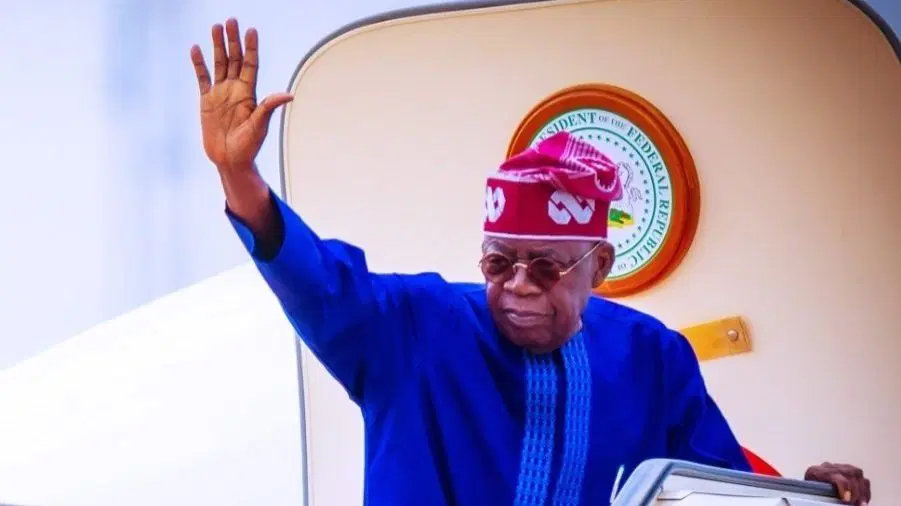
AN examination by Standarddailypress showed that on December 24, multiple payments for the same purpose were made through the State House sub-accounts and to private travel agencies.
A review of Nigeria’s public payments portal, Govspend, reveals that the Presidency under President Bola Tinubu spent approximately N1.5 billion on air tickets in a single day.
An examination by Standarddailypress showed that on December 24, multiple payments for the same purpose were made through the State House sub-accounts and to private travel agencies.
The data show that on December 24, a sum of N237 million was paid into the State House sub-account for the purchase of air tickets. On the same day, another N134.4 million was also paid into the same account for air ticket purchases.
Further scrutiny of the records indicates that the Presidency also made payments directly to travel agencies on that day. A sum of N226 million was paid to Overland Travels and Tours Limited for the purchase of air tickets on December 24.
In addition, the Govspend portal shows that N239 million was again paid into the State House sub-account on the same day for air ticket purchases.
This was followed by another payment of N346 million into the same account, also listed as expenditure for air tickets.
The pattern of spending continued with more payments to travel firms. On December 24, a sum of N153.5 million was paid into the account of Overland Travels and Tours for the purchase of air tickets.
On the same day, N96.8 million was paid to Travel Options Limited for the same purpose.
Records further show that an additional N136.5 million was paid to Overland Travels and Tours Limited on December 24, again for the purchase of air tickets.
When all the payments listed for that day are combined, the total amount spent by the Presidency on air ticket purchases comes to approximately N1.5 billion in a single day.
The payments, as reflected on Govspend, were processed through both the State House sub-accounts and private travel agencies, with several transactions carrying similar descriptions and purposes.
The revelation comes amid growing public scrutiny of government spending, particularly on recurrent expenditures, at a time when many Nigerians are grappling with rising living costs and economic hardship.
The Govspend portal was created to promote transparency in public finance by allowing citizens to track how government funds are spent.
However, the scale and frequency of the payments recorded on December 24 have raised questions about the cost of official travel and the management of public resources within the Presidency.
Earlier, a Standarddailypress review of the 2026 Nigerian budget showed that a sum of N6.1 billion was planned to be spent by President Tinubu on international travels in the fiscal year.
The amount is listed in the budget breakdown under State House operations – President.
According to the breakdown, the President also plans to spend N873 million on local travels during the fiscal year.
Vice President Kashim Shettima is expected to spend N1.3 billion on foreign trips in the 2026 fiscal year.
In total, President Tinubu and his Vice, Shettima, plan to spend N7.4 billion on foreign trips in 2026.
A review of Nigeria’s 2026 budget documents shows that the government plans to spend a total of N6 billion on overhauling aircraft engines in the Presidential fleet.
Details indicate that the overhaul of the 5N-FGW engines alone is expected to cost N3.859 billion. The 5N-FGW refers to a specific Gulfstream G550 business jet (Serial Number 5310) used by the Nigerian Air Force as part of the Presidential Air Fleet.
An additional N2.19 billion has been budgeted for the overhaul of two Falcon 7X engines, bringing the total planned expenditure on engine overhauls to N6 billion.
The budget also allocates N1.2 billion for aircraft maintenance and N1.5 billion for fuelling the Presidential fleet. Furthermore, repairs to the air navigation system are projected to cost another N6 billion.
These figures have fuelled concerns over the costs of President Tinubu’s travels, which critics say have already consumed several billions of naira in public funds.