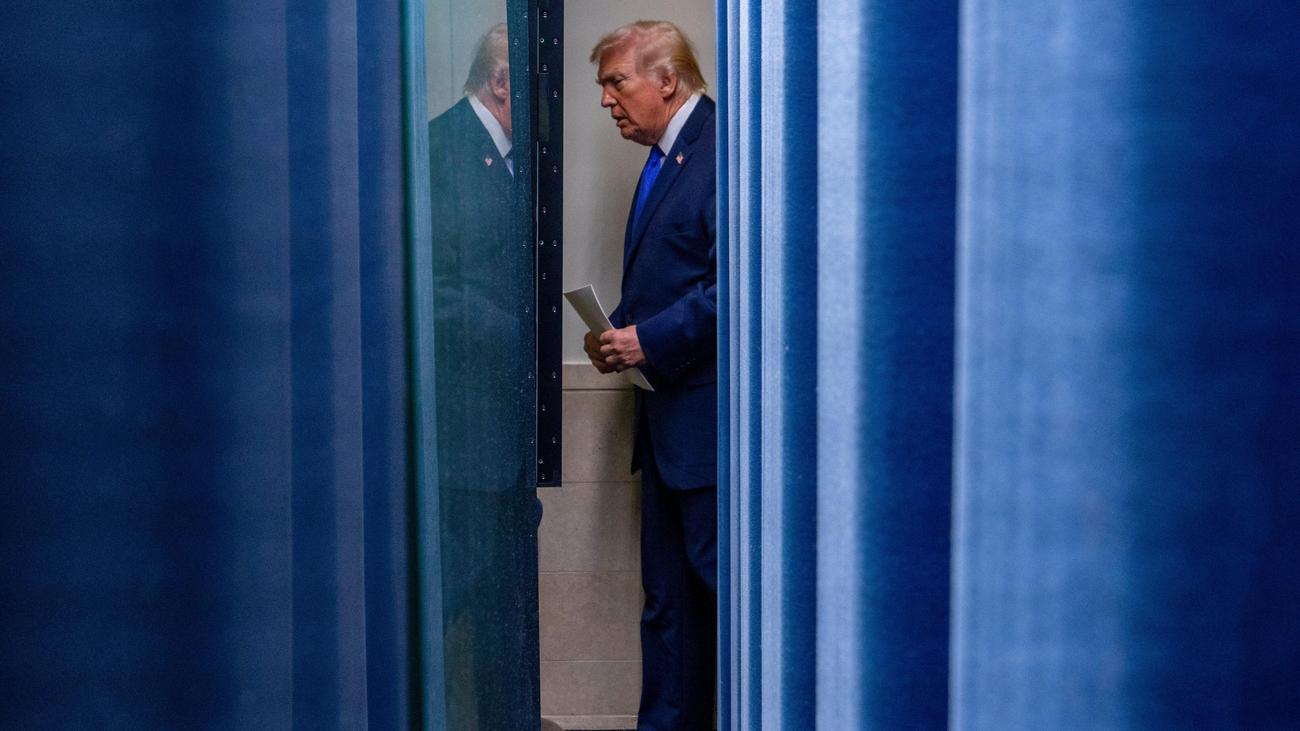
After the US Supreme Court ruled against President Donald Trump imposed tariffs, reactions around the world are mixed. Chancellor Friedrich Merz has announced that he will travel to Washington with a coordinated EU stance to US President Donald Trump to discuss the changed situation with US tariffs. “This is an interesting decision that many people also expected that the Supreme Court in Washington would show the government limits here as far as customs policy is concerned,” said Merz in an interview with ARD in Stuttgart after the end of the CDU federal party conference. However, the ruling does not affect the so-called sector tariffs, but rather the general tariff rate introduced by Trump.
Before he speaks to Trump in just over a week, “we will coordinate with each other in the European Union and we will have a very clear European stance on this,” announced the Chancellor with a view to his planned trip to the country USA to. “Customs policy is a matter for the European Union, not for individual member states. I will go to Washington with a coordinated European position.” He wanted to make it clear to the US government again that tariffs hurt everyone. “Above all, it harms the country that imposes the tariffs.” Germany bears the burden because the economy delivers less. “But customers in the USA have to pay more.”
Brussels also initially reacted cautiously. The EU According to French Foreign Trade Minister Nicolas Forissier, France has the tools it needs to respond to the latest US tariffs. “Should it become necessary, the EU has the appropriate instruments at its disposal,” said Forissier der Financial Times. He called on EU member states to show unity.
According to the report, the response could include options such as the Anti-Coercion Instrument (ACI). ACI stands for Anti‑Coercion Instrument, it is an EU legal instrument against economic coercion: If a country wants to force the EU to make concessions through trade or investment measures, the EU can, among other things, restrict trade and investment, control exports, impose tariffs even on services and exclude US companies from EU procurement and procurement contracts. This would also affect US technology companies. The instrument is therefore also known as a “trading bazooka”.
There is also a currently dormant package with retaliatory tariffs on US goods worth more than 90 billion euros. According to Forissier, France is currently holding talks with EU partners and the European Commission to coordinate further action. “We can no longer be naive,” Forissier said. “We have to use our tools and not just talk about them.”
EU will discuss on Monday
The European Parliament will meet on Monday to consider last year’s ratification Washington agreed trade agreement. This could be postponed further.
French President Emmanuel Macron welcomed the decision of the US Supreme Court from the perspective of separation of powers. It is good to have counterweights to power and the rule of law in democracies, he said on the sidelines of an agricultural trade fair in Paris. France will examine the consequences of Trump’s new global tariffs of ten percent, but will continue to export its products.
Economist and head of the Italian central bank, Fabio Panetta, said at a conference in Venice that consumers would now bear half of the tariffs imposed. It is estimated “overall that tariffs contributed just over half a percentage point to inflation.”
of India The Ministry of Commerce said it was now examining developments following the customs ruling. The US and India announced a framework for a preliminary trade agreement in February after months of stalled negotiations. India’s tariff burden on the US would fall to 18 percent from the current 50 percent – one of the highest in the world – after New Delhi agreed to open its economy to imports of most American manufactured goods as well as some food products. On Friday, US President Trump assured India that nothing would change in the deal.
Trump is traveling to China at the end of March
In China quoted the pro-government newspaper Global Times a scientist who criticized how stubbornly the Trump administration reacted to the ruling and warned of a “period of turbulence in US customs policy.” The US President himself also chose a similar wording. Trump will travel to China from March 31st to April 2nd to negotiate an extension of the trade ceasefire. “These will be turbulent conversations,” Trump said of the visit, which the White House confirmed.
Japan, however, wants to wait and see further developments. Japanese government advisers said the Supreme Court ruling could overshadow the planned summit in Washington in March between Trump and Japanese Prime Minister Sanae Takaichi, according to the FT report. It is unclear whether Japan will reopen the agreement with the USA that was negotiated last year. The country was the first country to conclude a tariff agreement worth hundreds of billions with the USA.
Meanwhile, Indonesia called on the US not to impose tariffs on certain of the country’s exports, as agreed. This applies, among other things, to palm oil, coffee and cocoa, says Economics Minister Airlangga Hartarto.
A spokesman for the South Korean presidential office said the ruling had “undoubtedly increased uncertainty in the international trade environment.” The Commerce Department said that even though the ruling lifted Korea’s 15 percent tariff, other tariffs imposed under other laws remained in effect, including levies on cars and steel, two key Korean exports.
Taiwan is also closely following the latest US tariff decision. “While the immediate impact on Taiwan appears limited, the government will closely monitor developments and remain in close contact with the United States,” the island’s cabinet said. In this way, Taiwan can understand how the decision is applied in detail and respond appropriately, it said.
With material from Reuters