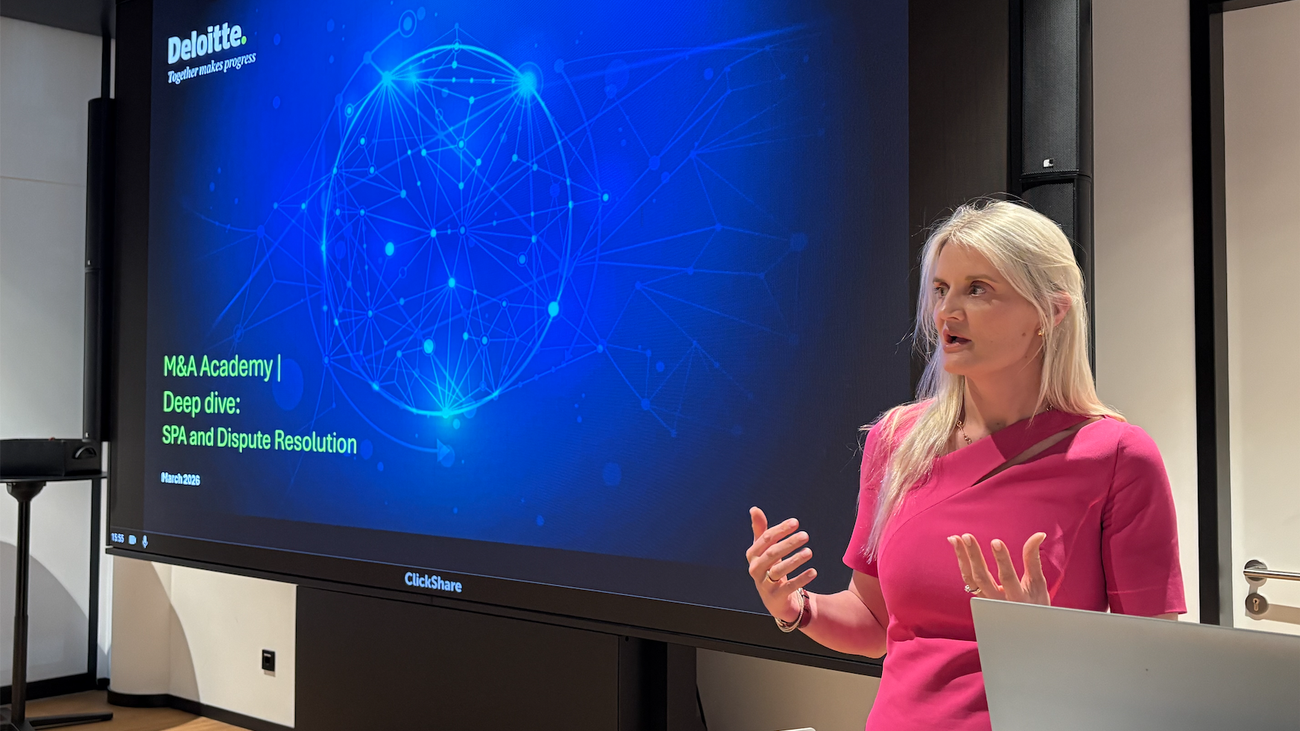
When companies are bought or sold, it’s about strategic decisions: about growth, about new markets, about investments – and about the question of how business models will develop further. In short: corporate takeovers shape entire industries. Isabelle Pernegger has been working in exactly this environment for many years. As a partner at Deloitte, she heads the Transaction Diligence department for Mergers & Acquisitions (M&A) in Nuremberg. A professional field that is strategic, highly dynamic and still strongly male-dominated. Why actually? We asked her.
Ms. Pernegger, you work in transaction diligence and M&A. What happens when a company is sold or bought and what role do you and your team play?
Essentially, we accompany companies or investors through the entire transaction process. If a company is to be sold, it is first presented in a structured manner: with numbers, analyzes and sometimes even a business plan. Prospective buyers check this information very carefully before deciding whether they want to buy and at what price. We prepare the financial foundations, analyze risks, question plans and help to realistically assess the value of the company. It’s about creating transparency and providing a well-founded basis for decision-making.

What attracted you personally to this field?
I’ve always been fascinated by how close you are to big business decisions. Purchases and sales are always an expression of strategy: which markets does a company want to enter, how does it want to grow, what risks is it willing to take? This mix of analysis, strategy and dynamics was what appealed to me. And you sense very early on what is becoming economically and politically relevant.
How do you notice this? Do you have an example?
When Brexit became concrete, we suddenly had a lot of projects in Great Britain. During the Corona pandemic, a lot of things revolved around software and digital business models. Such developments are often reflected more quickly in our area than in others.
The business is very project-driven, often at short notice, and you work under high time pressure. How do you experience this pace?
It is indeed a highly dynamic environment. There is no classic pipeline: sometimes a call comes and a team is ready a few days later. Projects can last for months and end very quickly if risks emerge that make a deal impossible. This volatility is part of it. It requires organization, decisiveness and, above all, a well-coordinated team that takes responsibility. At the same time, it helps to have a certain level of composure when dealing with pressure – and the ability to make decisions pragmatically and without long hesitations.
You have been working in the industry for 19 years, are now responsible for a large team at Deloitte and have helped set up a location. What is important to you in leadership?
On trust and clarity. It is important to me that people can develop. I benefited greatly from being able to take on responsibility early on and try things out. I’m trying to pass that on. For me, leadership means enabling people to work independently and make decisions. This includes allowing experiences – and, if in doubt, providing support in good time.
For me, leadership means enabling people to work independently and make decisions
How can this be achieved without taking risks for clients?
It is clear that mistakes must not be to the detriment of our customers. But further development requires practice. Therefore, as a manager, it is my job to create a controlled framework: transfer responsibility, provide close support and intervene in good time when things become critical. Especially in a complex environment like M&A, it is important that people not only understand the processes theoretically, but also understand the situations themselves.
If you look at the M&A sector, the management levels are predominantly male. How do you perceive this and what does it mean for your work?
Mixed teams bring in different perspectives – this is a technical advantage because decisions are discussed more broadly and made less one-sidedly. Women often approach issues in a very fact-oriented and less hierarchical manner, while men are often more anchored in networks. Both have their value. It’s true that the proportion of women in my area is still low, also because comparatively few apply. Things are slowly getting better, but targeted impulses are needed to achieve structural diversity.
In your opinion, why is it that so few women have chosen this path so far?
Many women have respect for the environment, for the pace, for the working hours, for the idea of a rough tone. For a long time I thought that performance was the only deciding factor and that special funding formats were not necessary. Today I see that there is a need for spaces in which questions can be asked and reservations can be openly addressed. That’s why initiatives, exchange formats and programs only for women are important – at least until a real mix is achieved.
Management consulting is considered demanding. At the same time, many talented people today value pursuing a career without sacrificing family or free time. What has changed here?
Flexibility is more commonplace today: remote work, understanding of family obligations – and this applies to both men and women. There are also fathers in my team who want to attend family appointments, and that’s right. At the same time, the phase with small children remains demanding and yes, our job is demanding. At Deloitte there are various formats and offers, networks and events that create a framework for open exchange. The “Women at the Wheel” initiative, for example, offers female empowerment and networking in the automotive industry, while the family service or the “Working Parents Network” provide relief with advice and action. I find that these offers and networking opportunities help. And that women are increasingly confident about taking this path.
You address networks. What role have networks and mentors played in your own career?
A big one. Networks are not short-term career tools, but long-term relationships: exchange, perspectives, sometimes advice at the right time. Sponsors who believe in you and support you are very important in crucial moments – for example when it comes to the next step. This can make all the difference, especially for women.
Thank you for the conversation.