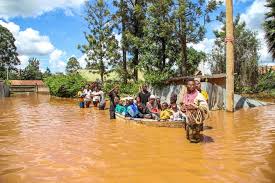
Kenya is battling a devastating flood crisis that has displaced tens of thousands of people, destroyed homes, cut off communities and pushed the country into yet another painful climate emergency.
After weeks of relentless rainfall, large parts of the country have been overwhelmed by rising floodwaters, with the destruction stretching from the capital, Nairobi, to sections of the Rift Valley and the Tana River basin. What began as heavy seasonal rain has now spiralled into a full-scale humanitarian emergency, leaving many families with nothing but whatever they could carry before the water took over.
Across affected areas, roads have disappeared beneath muddy water, homes have been washed away, and key infrastructure has been badly damaged. In many communities, daily life has simply stopped.
And for thousands of people, survival has become the only immediate concern.
Government officials say the death toll has continued to rise, with dozens already confirmed dead and several others still missing. Rescue teams have been working under intense pressure, trying to reach stranded residents in communities that are now either submerged, isolated or completely inaccessible.
But the scale of the disaster is making response efforts incredibly difficult.
In many places, emergency services are overstretched, and help is struggling to move as quickly as the floodwaters themselves.
The Kenya Red Cross Society has been leading much of the rescue and relief effort, deploying teams to evacuate trapped residents, distribute food and provide temporary shelter. Yet even with those interventions, aid agencies are warning that the situation is rapidly becoming bigger than the available resources on the ground.
That warning matters.
Because disasters like this do not only destroy buildings — they expose just how fragile many communities already are before the water even arrives.
In low-lying settlements and informal urban areas especially, the flooding has hit with brutal speed. Drainage systems in many of these communities are either weak, blocked or completely inadequate, which means when the rains intensify, whole neighbourhoods can go under almost overnight.
And that is exactly what many families have experienced.
One of the hardest-hit areas is Tana River County, where swollen rivers have reportedly burst their banks and swept through homes, farmlands and livestock. For many residents there, the flood is not just a temporary disaster. It is also an economic collapse.
Because when floodwater wipes out your crops, your animals and your home at the same time, recovery becomes far more than just rebuilding walls. It becomes about restarting life itself.
And that is where the crisis deepens.
Beyond the immediate destruction, there are now growing fears about public health. Schools have already been shut in several counties due to safety concerns, and health officials are warning about the risk of waterborne diseases such as cholera as clean water sources become contaminated.
That is often how flood disasters become even more dangerous after the rain begins to ease.
The first emergency is the water. The second is what the water leaves behind.
The Kenyan government has urged people living in high-risk areas to move to safer ground, but for many families, relocation is easier said than done. Some have nowhere else to go. Others are reluctant to leave behind what little they still have. And in many cases, poverty itself becomes part of the disaster, trapping people in danger even when they know they should leave.
That is one of the hardest truths in crises like this: vulnerability is rarely caused by rain alone.
It is worsened by inequality, poor infrastructure, weak planning and limited safety nets.
Climate experts say the severity of the flooding is also part of a much larger pattern. Across East Africa, weather systems have become increasingly unstable in recent years, with global warming intensifying rainfall and turning what should be seasonal weather into destructive, life-threatening events.
In simple terms, these are no longer “just floods.”
They are climate disasters arriving with growing force and frequency.
And while the current focus remains on rescue operations, food, shelter and survival, the bigger question Kenya now faces is how to recover in a way that does not leave the same communities exposed again and again.
Because once the waters finally recede, the real work will begin.
Families will need homes. Farmers will need support. Roads and schools will need rebuilding. Public health risks will need containing. And perhaps most importantly, the country will need stronger systems to prepare for a climate future that is becoming more dangerous by the year.
For now, though, that long-term conversation remains secondary to the immediate human reality unfolding across the country.
Right now, thousands of Kenyans are simply trying to stay alive, stay dry and hold on to whatever remains.