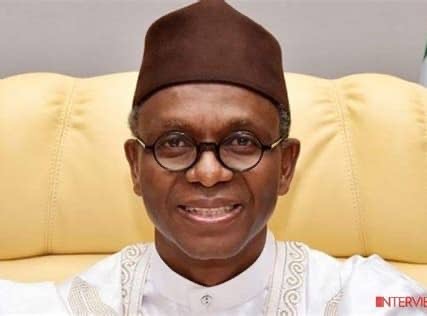
One can’t stop imagining that ‘Mallam’ Nasir El-Rufai, the diminutive immediate-past governor of Nigeria’s Kaduna State, ideally fits into the groove of Ivie’s analogy. Ivie, my eldest sister, often implied through her folklores that the ‘Tortoise’ is cunning and over-determined being that frequents and dominates strange tales, for bad than good. It isn’t just the only summation of Ivie, that El-Rufai, the little firestone, is so labelled.
In reminiscence of my childhood, I sat amidst my kin by a campfire, wallowing in the jumble-mumble of the ‘Tortoise’. It was always in the moonlit nights, when the Harmattan, a cold and tinder dry-season wind that blistered the lips, ran the tongue dry. In the evenings, indigestion set in after a hardened pounded-cocoyam’s super, with flatulence easing the rumbling bowels.
Ivie, a tomboy, again drew all to her mesmerising storytelling skills, which held the children bemused. Some elders often marveled at the dexterity to folklores, by a mere girl; a rare gift they did not have, no matter the experience and wisdom they arrogated to go with ripen age.
Though maligned in most tales but adored in only a few, the Tortoise is a bundle of problems and said to be naturally clever, a puzzle, that makes him, somewhat, a complex being. In later years, when the Nigerian Conservation Foundation (NCF) thought about a befitting title for a serial cartoon magazine, to facilitate conservation awareness and its inculcation by children and students, I had recalled and opted for the exciting world of Mr. Tortoise, hence ‘The Tortoise Magazine’.
It’s natural for all to err. But, how come a pernickety being is so hated by the world, no matter his supposed misdeeds? Why hate the Tortoise? Too much of everything is bad. Not doing anything is also bad, if not worse. But, it is not all that is red that a hen must swallow, else it burns her beak in the fire ember.
El-Rufai is in deep trouble, because he romances troubles. The Edo people would call it; “Tẹ ọfọ gha fi ọvbokhan nọ fi obọ yẹ onisan egui”. A child who pushes his hands in the buttock of a tortoise definitely sweats it out. That’s why tongues wag when beer and pepper soup joints are agog that the ‘macho man’, who once bragged that “he is Arewa and Arewa is him”, had been locked away by the Independent Corrupt Practices and Other Related Offences Commission (ICPC), a hitherto fierce-less one that had grown the fangs overnight, unlike the fire-eating E Economic and Financial Crimes Commission (EFCC) and Department of State Service (DSS).
That El-Rufai is the beginning and the end of Arewa and the oxygen of its people, could be deduced as Arewa, excepting for muffled condemnations of his arrest by some of his political associates, went to sleep as he cooled off his feet in detention. That reminds me about what our people say that “ọmwan nẹ rho owa ẹre ọgbe olakpa” – It is only those away from home on the day of arrest that fight and thwart the policemen. Where were those who boasted that ‘over their body’, El-Rufai must not be arrested? As governor, El-Rufai was the one-man-gang and almighty czar of Kaduna, in a manner the ‘Kaduna Mafia’ was not feared.
Still on his boast that he has pocketed Arewa, the Nigeria’s North, a litmus test to that facade is the National Assembly, with majority membership of EL-Rufai north, that turned down his nomination as a minister.
What does it profits a politician to deep his legs to gauge the depth of every river he crosses? A man who passes all roads without items stolen. There are thievery allusions to his former office as a chaotic minister of the Federal Capital Territory, just as he is alleged to have committed humongous frauds, as former governor of Kaduna.
A litany of woes characterise El-Rufai, on his awkward public conducts and wreckless statements. In a buildup to the re-election of his former and late boss, President Muhammadu Buhari, El-Rufai’s unguided media comments were that foreign election monitors stay back in their home countries and not come to intervene in that Nigeria’s general election, otherwise they would be returned home in body bags. Also on the heels of the same presidential election, El-Rufai had defiantly told the world that it was normal for multitudes of the neighbouring Niger Republic to come and vote in Nigeria’s elections.
His could be likened to the futility of the Medusa complex, for a personality who lustfully upturns the public – old and new relationships, which altogether tone down to sadism. Medusa, in the ancient Greek mythology, was a woman with live snakes in place of hair; where anyone who looked upon her was turned to a stone.
In Nigerian politics of “anything goes’, friendship and team loyalty still averagely play out. The buccaneering politics played by the El-Rufais is, however, puzzling. Was it not the same man that energetically traversed the land to sell the Tinubu candidacy of the All Progressives Congress (APC) to his Northern people? Is he not the same man who once dined, wine and danced ‘Buga’ victory dance with a newly-elected President Tinubu, on network television?
Why couldn’t El-Rufai manage the relationship? Indications were that his point of divergent and animosity with the Tinubu’s bandwagon was when his ministerial nomination was declined by the Senate, whilst El-Rufai felt betrayed that Tinubu was after all behind his ordeals. El-Rufai’s zealousness and rebellion know no bound as his aligning with the opposition African Democratic Party (ADC) coalition, is said to exert a pound of flesh from Tinubu.
Friend today, enemy tomorrow, is the trapping of Nigeria politics. In ‘The Passport of Mallam Illiam’ (not of Mallam El-Rufai), storyteller Cyprain Ekwesi, unveils the Battle of Shanchi, where friends-turned-foes engaged in a deadly darkness ring fight, with sharp knives, to win the heart of a woman. The woman-prize of death, bloodletting and maiming, in this case of El-Rufai with others, is acrimonious politics. For the umpteenth, politics is like the seductive waist of a mistress that no man hangs to for long.
Ekhui ighi z’ ikpapka n’ ovbiẹre zi ifuẹn” The tortoise doesn’t have the shell and its heir grows the feathers. Like El-Rufai, his son, Bashir, takes after his father. Bashir, a House of Reps lawmaker is also wet in lawbreaking. Against an agreement by legal luminaire, Femi Falana, that El-Rufai’s court’s trial and detention were legal, Bashir criticised it as an abuse.
When the court granted El-Rufai a temporary release, on compassionate grounds to go bury his late mother, Bashir and others are quick to say that his sudden release signified that his court trial and detention were undertones that the charges were trump-up.
On the El-Rufai’s bereavement, the Northern Christian Youth Professionals, a part of the religious group El-Rufai had persecuted as a former governor, rightly said that the decision demonstrated compassion and respect for human dignity and values by the Tinubu administration’s approach of “humanity above politics”
“When Maikori Died In Sept 2020, Audu was prevented from attending his burial by El-Rufai”. Recollected Chidi Odinkalu, a renowned human rights activist. Mallam Adamu Maikori, a titled man, passed away on september 2020, but his son, who was supposed to bury him, was exiled by Nasiru El-Rufai. It, however, points to the unsympathetic and unforgiving miens of a El-Rufai and his son. Bashir El-Rufai publicly umbraged Shehu Sani, a known critic of El-Rufai, for sending condolences to El-Rufai on the death of his mother.
Blindfolded by ‘the bala blue’ gaffe and ‘tripings’, the El-Rufai-hyenas, like a juvenile story, ‘When The Lion Was Ill’, were actually cajoled to believing that the Lion (Tinubu) was actually ill and impaired forever. Tinubu is a fox, and not a Goodluck Jonathan, a cool-cat that was stoned at will, said Fred Atururu, a public affairs analyst, who chipped in; “Tinubu non be Jonathan”.
In one of her memorable stories, Sister Ivie’s narration could have been a repetition by El-Rufai, who toys with the public emotion, to feather his selfish nest. In his well publisised brush with the EFCC at the Abuja Airport, El-Rufai, the ‘clever Tortoise’ with his retinues, had dared the authorities to arrest him.
The Tortoise deviously urged the king to tie him to the stake, over a crime he had committed, so that the public would say the king’s action was justified. And that he, Mr. Tortoise, had finally met his end. And so he was tied to the stake.
For the Tortoise, he knows that passersby, particularly the women, are not consistent and that those who condemned the Tortoise for wrongdoings, as they went in the morning, are the same who will turn against the king, blaming him as inhumane, for leaving the Tortoise on the stake, from morning till night.