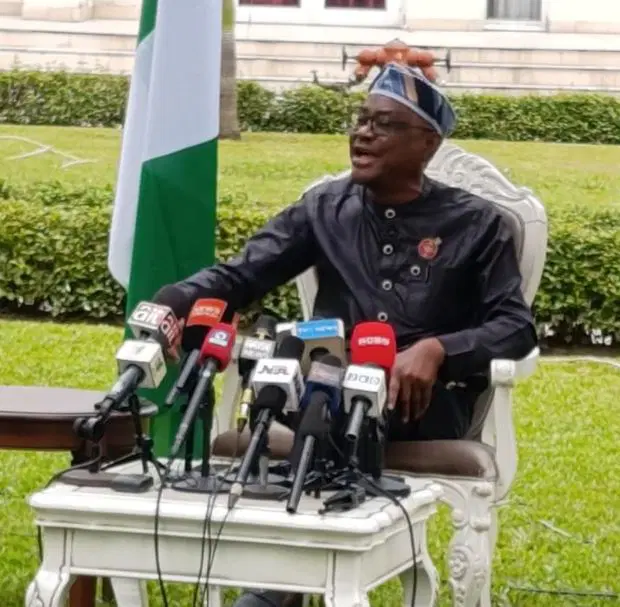
Nyesom Wike has once again positioned himself at the centre of the PDP’s internal power battle, declaring that the party will be rebuilt to reflect what he called the “yearnings and aspirations” of Nigerians, while also taking direct shots at defectors and former allies.
Speaking at the PDP’s 10th elective national convention in Abuja on Sunday, the Minister of the Federal Capital Territory tried to frame the gathering as more than just a routine party event. For him and his loyalists, it was a symbolic show of survival, ownership and control.
Wike said the PDP must return to its original identity as a people’s party, arguing that the future of the opposition platform should be built on “inclusiveness, unity and renewal.”
“Together with all and sundry across all the nooks and crannies of our country, we shall rebuild our party in such a way that it will meet the yearnings and aspirations of the generality of Nigerians,” he said.
That line was clearly crafted to sound broad and reconciliatory, but the rest of his speech carried a much sharper political message.
He called on former members and aggrieved stakeholders to return, insisting that “no one would be excluded” and that everyone would be given “equal opportunity to serve in unity and love.” On paper, that sounds like reconciliation. In reality, it is also a message of dominance: come back, but on the terms of the camp that now believes it has taken back the structure.
And that was really the core of Wike’s speech.
He said PDP loyalists had fought through what he described as a “tragic crisis of leadership” and had successfully wrestled the party away from forces he accused of undermining internal democracy and the rule of law.
“We fought and returned the party to its rightful owners, the people,” he declared.
That statement is not just rhetoric. It is a direct political claim.
What Wike is saying, in essence, is that the PDP faction he now leads or heavily influences sees itself as the legitimate centre of authority in the party, especially after months of bitter internal wrangling, legal disputes and high-profile exits.
He also praised grassroots members for staying loyal even while, in his words, “opportunistic elites” moved from one political party to another for selfish reasons.
That jab was not subtle.
Wike has increasingly built his recent political messaging around the idea that many so-called “big men” in Nigerian politics are fair-weather actors — people who use parties as temporary ladders, then abandon them once things get rough.
And that criticism became even more direct when he addressed governors and major figures who have distanced themselves from the PDP.
“When our governors were seeking a platform to become governors, they found one and achieved their ambition. But when crises emerged, and it was time to demonstrate leadership, vision and courage, they ran away,” he said.
That is one of the most politically important lines from the speech.
It reflects Wike’s long-standing frustration with what he sees as cowardice, convenience politics and selective loyalty inside the opposition. To him, leadership is not tested when a party is winning — it is tested when the house is on fire.
And by that standard, he believes many of the party’s former power brokers failed.
He even widened the criticism beyond governors, warning Nigerians to be cautious of politicians who seek high office but disappear once things get difficult.
“They seek positions, even aspire to lead the country, yet when faced with challenges, they withdraw. So, we must be careful about such actors,” he said.
That line is clearly aimed at more than just PDP defectors. It also feeds into Wike’s broader attempt to shape the opposition narrative ahead of 2027.
Because make no mistake: this speech was not only about rebuilding the PDP. It was also about defining who gets to speak for the opposition in Nigeria going forward.
And that matters a lot.
Right now, the PDP is still battling a crisis of relevance. The party remains one of Nigeria’s biggest political structures, but it is also deeply bruised by defections, internal factionalism, leadership distrust and years of strategic confusion.
So while Wike’s speech projected confidence, the real question is whether the PDP can actually transform that energy into a coherent national comeback.
That will depend on more than convention speeches and symbolic declarations.
It will depend on whether the party can:
- genuinely reconcile rival blocs,
- rebuild trust among its base,
- stop elite infighting,
- and present a clear ideological and electoral alternative before 2027.
Because if the PDP remains trapped in personality wars and internal supremacy battles, then all this talk of renewal will sound good on stage but mean very little on the ground.
Still, one thing is now very clear:
Wike is not speaking like a man trying to stay in the background.
He is speaking like someone who believes the next chapter of the PDP — and perhaps even the wider opposition story in Nigeria — will not be written without him.