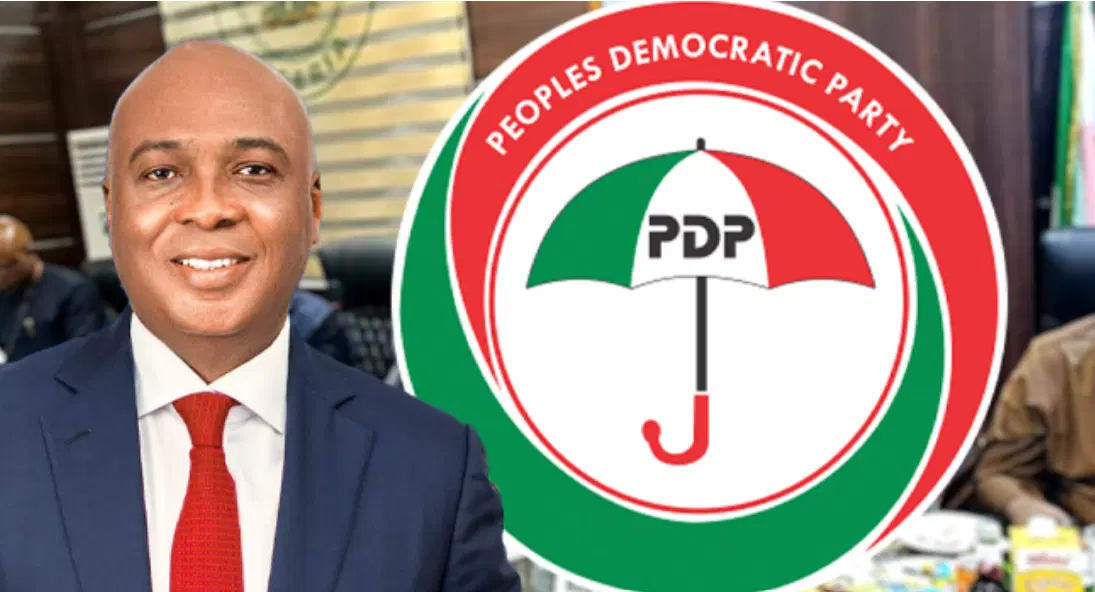
Bukola Saraki’s message to the PDP was blunt, timely, and honestly, a little embarrassing for the party: it would be “shameful” if the PDP somehow talks itself off the 2027 ballot.
That is not the kind of sentence any major opposition party should even be close to hearing.
Speaking at the PDP’s 2026 National Convention in Abuja, the former Senate President did not try to pretend all was well. Instead, he went straight to the real issue: before the PDP can talk about winning power, it must first make sure it remains a functional political platform.
And that says everything about where the party is right now.
“Let us be able to allow people that want to contest for 2027 on PDP platform. It would be a shame if, by an own goal, one way or the other, we’re not on that ballot,” Saraki said.
That phrase — “own goal” — is the most important part of what he said.
Because Saraki is not blaming the APC here. He is not blaming INEC. He is not blaming the courts. He is blaming the PDP’s self-inflicted chaos.
And he is right.
For a party that once ruled Nigeria for 16 uninterrupted years, it is remarkable that the conversation around the PDP in 2026 is not yet about who can win in 2027, but about whether the party can even hold itself together long enough to remain electorally relevant.
That is how deep the crisis has become.
Saraki tried to strike a hopeful tone, especially after seeing the turnout at the convention and the presence of INEC, which he said reassured him that the process had institutional legitimacy.
“When I walked in here, saw the attendance, saw INEC here, I said… Alhamdulillah. Because that’s the issue. Everything else… doesn’t matter,” he said.
That line may sound simple, but politically it is loaded.
What he is basically saying is: once the party’s convention is recognised and its structure remains valid, there is still something to salvage. Every other quarrel — ego battles, factional bitterness, regional camps, leadership rivalry — can still be dealt with later.
And that is the central survival logic of the PDP right now.
Saraki also made it clear that his reconciliation push is not just about party elders making peace for appearance sake. According to him, the bigger concern is for ordinary aspirants and party members who still need a platform to pursue their political future.
“They’re excited that now they can follow their ambition, because now they have a platform and PDP can provide that platform,” he said.
That is a very practical political point.
Because once a party starts looking unstable, the first people to panic are not always the big names. It is often the young aspirants, state-level hopefuls, House of Assembly contenders, local government actors, women leaders, youth organisers, and first-time contestants who begin to wonder whether they are tying their future to a collapsing structure.
Saraki is effectively saying: leaders can fight later, but they must not destroy the platform for everyone else.
That is a serious warning.
He also acknowledged that the road to the convention was rough, saying he and others involved in reconciliation had taken “a lot of attacks here and there.” That is not surprising. Anyone trying to mediate the current PDP mess will naturally become a target from all sides.
Still, he insisted that the doors should remain open for those who stayed away.
“For those who are not here, I hope that the doors are not closed… I will continue to talk to them and engage with them,” he said.
That is probably the most mature part of his intervention.
Because whether some factions like it or not, the PDP cannot afford to rebuild as a victory parade for one camp alone. If it becomes a party of “we defeated them internally,” then 2027 may arrive before they finish celebrating internal supremacy.
And that would be politically foolish.
Saraki’s broader point is simple:
The PDP does not have the luxury of endless self-destruction anymore.
Not after 2023.
Not after defections.
Not after leadership battles.
Not after losing trust in key places.
If the party still wants to matter nationally, then the priority now is not ego. It is structure, legitimacy, unity, and ballot survival.
Because truly — and Saraki is right on this — for a party of PDP’s size and history to miss or weaken its place on the 2027 ballot through internal confusion would not just be a political setback.
It would be a humiliation.