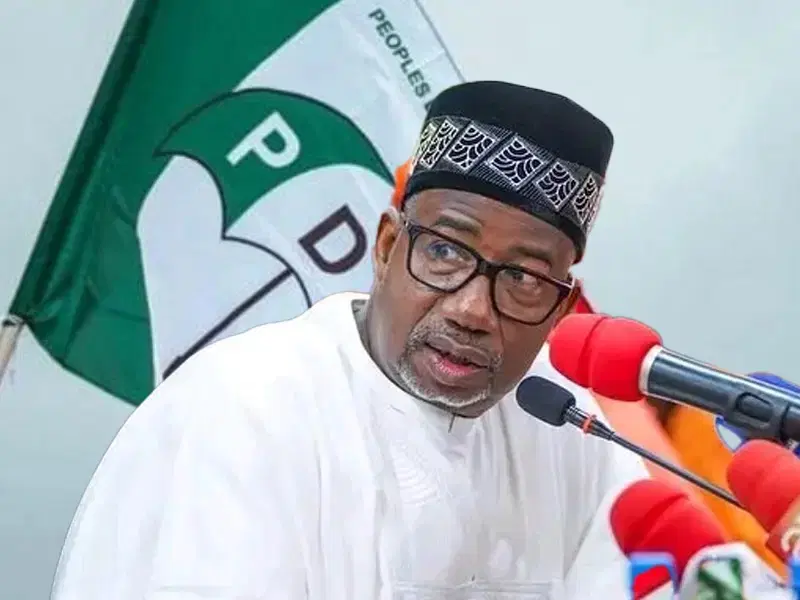
The crisis rocking the Peoples Democratic Party, PDP, took a dramatic new turn as Minister of the Federal Capital Territory, Nyesom Wike, and Bala Mohammed openly traded heavy accusations over the governor’s looming exit from the party.
What was once internal party tension has now become a full public political war.
At the centre of the clash is Bala Mohammed’s possible defection from the PDP to either the All Progressives Congress or the African Democratic Congress. And from the look of things, both camps are no longer pretending. The gloves are off.
Bala Mohammed, who currently chairs the PDP Governors’ Forum and remains one of the most prominent figures still inside the troubled party, appears to be seriously weighing his options. After hosting leaders of the ADC and APC in Bauchi, he made it clear that he is no longer comfortable in the PDP.
According to him, he did everything possible to restore peace in the party, but all efforts failed.
The governor directly blamed Wike for the PDP’s deepening crisis, saying the former Rivers governor was unwilling to reconcile and had effectively positioned himself as the one in control of the party. In Bala’s telling, he reached out to everyone that mattered — including APC leaders, Wike himself, and even President Bola Tinubu — all in a bid to stabilise the PDP before considering a way out.
That admission alone is politically explosive.
Because while Bala presented it as a reconciliation effort, Wike immediately turned it into ammunition.
And Wike did not hold back.
Speaking during a project inspection in Abuja, the FCT Minister mocked Bala Mohammed’s possible exit from the PDP, describing it as “good riddance to bad rubbish.” In typical Wike fashion, he didn’t just respond — he went for the jugular.
According to him, Bala’s current political movement is not about ideology or principle. He painted it as a desperate survival mission by a politician who tried to negotiate his way into the APC but was allegedly rejected.
Wike claimed Bala met President Tinubu three times in an attempt to secure political concessions, including the opportunity to handpick his successor and allegedly position himself for future relevance. He also claimed the governor came to him privately for help in navigating PDP power arrangements, including a request related to party positions.
In Wike’s version of events, Bala is not leaving PDP because he is principled. He is leaving because both APC and PDP allegedly refused to give him what he wanted.
That is the kind of accusation that cuts deep in Nigerian politics.
Because once a politician is seen as moving not for conviction but for personal bargaining, public sympathy starts to disappear.
Wike also accused Bala of inconsistency and political double-dealing. He alleged that in 2022 and 2023, Bala privately expressed willingness to work for Tinubu and even spoke dismissively about former Vice President Atiku Abubakar, only to later return to Atiku’s camp when it suited him.
If true, that paints Bala as politically restless. If false, it still shows just how much internal dirt major politicians are now willing to spill once relationships break down.
And that is the real headline here.
This is no longer just about defection.
This is about how badly broken the PDP has become.
Because when two senior figures in the same political family start publicly exposing private meetings, backdoor negotiations and internal horse-trading, it tells you one thing clearly: trust inside the party has collapsed.
The bigger danger for PDP is not just losing Bala Mohammed.
It is what his exit would symbolise.
If a sitting governor and chairman of the PDP Governors’ Forum can openly say he tried everything and still found the party irredeemable, then that becomes a serious image problem. It sends a message to party members, power brokers and undecided political actors that the PDP may no longer be a stable platform ahead of 2027.
And timing matters here.
With 2027 already beginning to shape elite political calculations, every defection, alliance and public quarrel now carries more weight than usual. Nobody wants to remain in a sinking structure if they believe another platform can offer a clearer route to power.
That is why the ADC is suddenly looking attractive to many political figures.
Not necessarily because it is already stronger than the APC or PDP, but because it is beginning to look like a possible landing zone for frustrated heavyweights looking for a fresh arrangement.
Bala Mohammed appears to understand that.
But Wike also understands something else — if enough influential people leave the PDP and successfully regroup elsewhere, his own grip on what remains of the party may eventually mean less.
So this fight is also about territory.
It is about who still controls political relevance.
Wike’s final comments made that part even clearer. He openly suggested that Bala had already “lost” politically in Bauchi and implied that the governor’s local structure had been weakened. He even threw in a side jab at Seyi Makinde, hinting that more people might eventually follow Bala out.
That kind of language shows this is no longer a disagreement.
It is a power contest.
And one thing is obvious: neither side is interested in peace anymore.
For Bala Mohammed, the next move must now be strategic and decisive. If he defects, he must make it look like leadership — not rejection. If he stays, he must explain why he remains in a party he has publicly described as deeply troubled.
For Wike, the danger is different. While his blunt style energises supporters, it also keeps reinforcing the belief that he has become one of the central engines of PDP instability.
So in trying to look strong, he may also be confirming the very accusation Bala is making against him.
And that is why this fight matters beyond the insults.
Because whether Bala joins APC, ADC or remains in PDP, one thing is already clear — the PDP is still bleeding, and the wounds are no longer hidden.