Nigeria’s political space don hot again — and this time, the fight is between the Independent National Electoral Commission (INEC) and the African Democratic Congress (ADC). What looked like an internal party issue has now grown into a full-blown national controversy, with opposition figures, pressure groups, and even the Presidency all throwing punches from different corners.
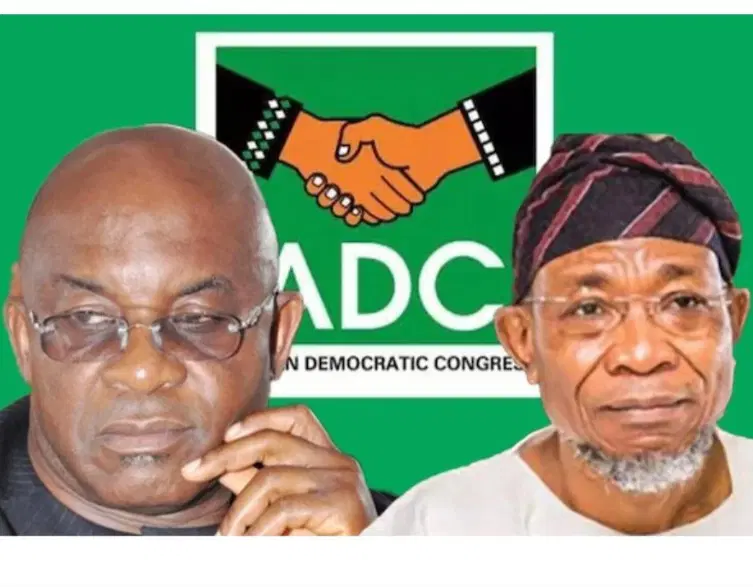
At the center of the storm is INEC’s decision to stop recognising Senator David Mark and Ogbeni Rauf Aregbesola as National Chairman and National Secretary of the African Democratic Congress. That single move has now opened a wider debate about democracy, political control, and whether Nigeria’s opposition parties are being deliberately weakened ahead of the 2027 elections.
For the ADC and its supporters, this is not just about names being removed from a portal. To them, it is a serious warning sign. They believe the move could cripple their ability to organise, participate in upcoming elections, and present themselves as a strong opposition force. That is why many within the party are now openly accusing INEC of taking sides in a battle it should be neutral in.
At a packed press briefing in Abuja, Senator David Mark did not hold back. He questioned why President Bola Ahmed Tinubu would still be afraid of opposition if the ruling All Progressives Congress already controls most of the National Assembly and more than 30 governors. In his view, if a government is truly confident in its performance, it should welcome competition instead of appearing threatened by it.
Mark and his camp insisted that their emergence as party leaders followed due process and was properly communicated to INEC. According to them, the commission was fully aware of the internal resolutions that produced the current leadership structure. So for INEC to now turn around and say it would no longer recognise them feels, to the ADC, like a political ambush rather than an administrative correction.
The legal side of the matter has made things even messier. The ADC says the court only ordered all parties to maintain the status quo ante bellum, meaning things should remain as they were before the dispute escalated. But the party argues that INEC has twisted that interpretation in a way that leaves the ADC in a leadership vacuum. In simple terms, they are saying: “You cannot claim to preserve order while creating confusion.”
INEC, however, is standing its ground. The commission says its actions are based on court orders and legal caution, not politics. According to the electoral body, monitoring any congress or convention organised by the disputed faction could amount to contempt of court. From its own perspective, it is simply trying not to worsen a legal dispute that is already before the judiciary.
Still, that explanation has not satisfied critics. Across the opposition, there is a growing feeling that INEC’s neutrality is beginning to look shaky. That is why voices like Peter Obi, Afenifere, the Middle Belt Forum, Ohanaeze Ndigbo, and others have all reacted with suspicion. Their fear is simple: if an electoral body can get entangled in internal party leadership disputes this deeply, what confidence should Nigerians have going into another election cycle?
Peter Obi’s reaction was especially sharp. In a post that stirred conversation online, he said it was ironic that some of the people who once fought against dictatorship are now behaving in ways that seem even less democratic than those they once opposed. It was a heavy statement — and one clearly aimed at today’s power structure.
The APC, expectedly, sees the matter very differently. Rather than accept the opposition’s victimhood narrative, the ruling party says the ADC caused its own crisis. APC spokesman Felix Morka described the ADC as a confused political arrangement that was never built on solid internal structure in the first place. In their telling, David Mark and Aregbesola did not stabilise the party — they invaded and complicated it.
That response is politically strategic because it shifts the blame away from government interference and back onto opposition incompetence. And to be fair, that argument may resonate with some Nigerians who believe opposition parties often spend too much time fighting internally instead of building clear alternatives for voters.
But even beyond APC and ADC, what makes this story important is what it says about the state of Nigerian democracy. If opposition parties are constantly dragged into legal, procedural, or administrative battles, it becomes harder for them to organise properly. And when the opposition looks weak or divided, the ruling party naturally becomes more comfortable.
That is why some groups are calling this moment dangerous. Not because one party is having leadership issues — that happens everywhere — but because of the timing and the pattern. We are gradually moving toward 2027, and every move now will be interpreted through the lens of power, succession, and control.
Another part of the drama that raised eyebrows was the heavy security presence around INEC headquarters in Abuja. Security agencies reportedly moved in to prevent clashes between rival protest groups. While authorities may argue that it was necessary to maintain peace, the optics did not help matters. To many Nigerians, it only made the whole situation feel more tense and politically loaded.
Then there is the practical issue the ADC and Afenifere raised: timing. If party registration windows and electoral timelines continue to move forward while leadership disputes remain unresolved, aspirants and loyalists may find themselves stranded. In Nigerian politics, timing is everything. So a delay today can quietly become a disqualification tomorrow.
At the heart of all this is one major question: is Nigeria still creating enough room for healthy political competition? Because whether you like ADC or not, whether you trust David Mark or not, the bigger issue is whether opposition parties are being allowed to breathe. Democracy does not become stronger when one side dominates everything. It becomes stronger when citizens can genuinely choose between real alternatives.
For now, the ADC says it will go ahead with its congresses and convention, with or without INEC’s presence. The party is clearly trying to project strength and confidence, even as the legal and political pressure builds around it. Whether that gamble pays off or deepens the crisis remains to be seen.
One thing is clear though — this is no longer just a party quarrel. It has become a test of institutions, a test of political tolerance, and a test of whether Nigeria is truly preparing for a competitive 2027 or simply rehearsing a controlled outcome.
If this continues the way it is going, Nigerians may soon stop asking whether the opposition can defeat the ruling party — and start asking whether the opposition will even be allowed to stand properly in the first place.