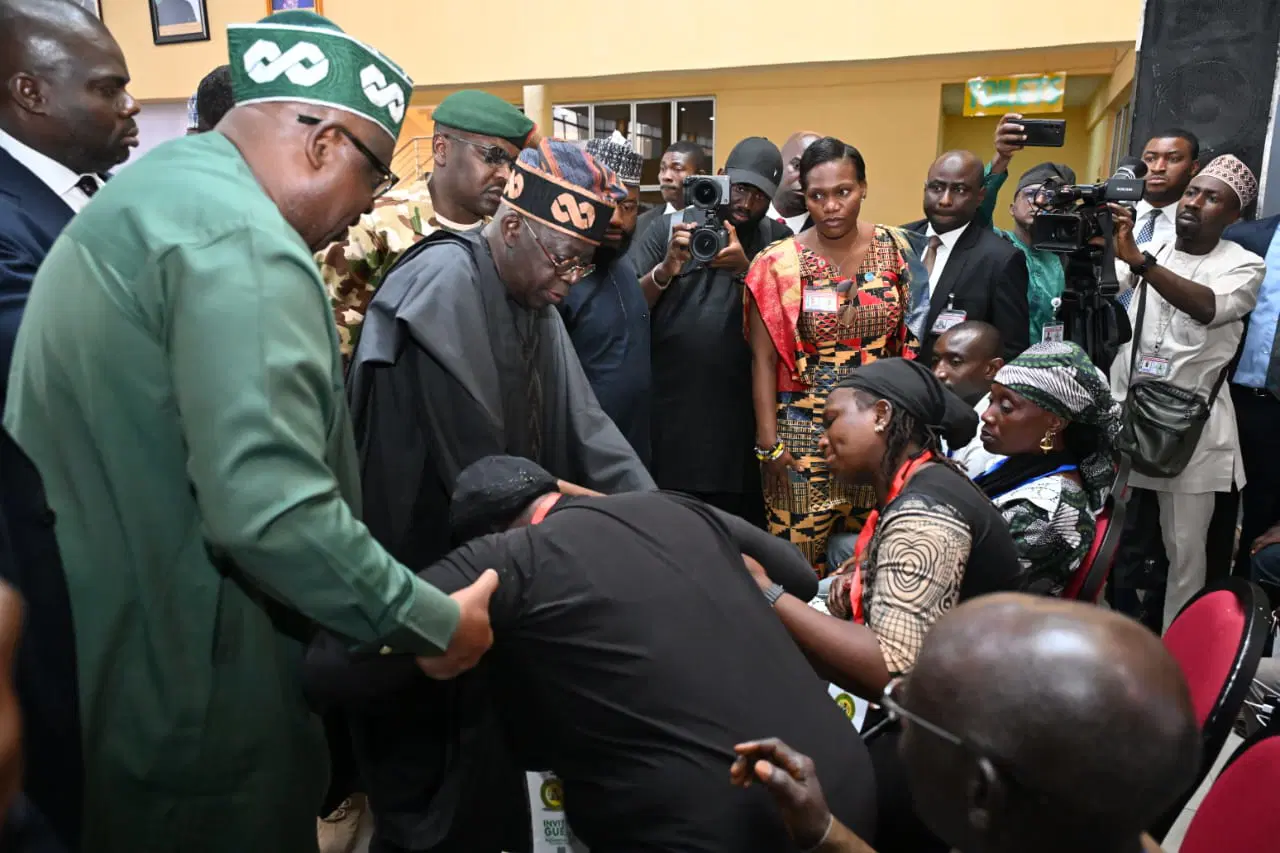
President Bola Ahmed Tinubu has ordered security agencies to go after those behind the killings in Angwan Rukuba, Jos North, Plateau State, following the bloody Palm Sunday attack that left more than 28 people dead and several others injured.
The President made the statement during a town hall meeting in Jos, where he addressed grieving families, traditional leaders, political stakeholders, and residents still struggling to process the horror of the attack. And to be honest, while the words sounded sympathetic, many Nigerians are still asking the same question they always ask after every massacre in this country: will anything actually change this time?
Tinubu tried to strike an emotional tone during the meeting, admitting that no amount of money could ever replace the lives lost. He told the victims’ families that government support would come, but more importantly, he promised that justice would be pursued.
According to him, the killers must be found and arrested, and he made it clear that the violence should not go unpunished. He also praised the police and military for their initial response, while charging them to do more than just show up after blood has already been spilled.
That part is where many people are paying attention.
Because in Nigeria, the issue is no longer whether leaders will condemn killings. They always do. The real issue is whether those condemnations ever translate into protection, arrests, prosecutions, and actual prevention. That is the part that keeps failing — and Plateau has become one of the most painful examples of that failure.
To show that the federal government wants to appear proactive, Tinubu announced that 5,000 CCTV cameras would be deployed across Plateau State to strengthen surveillance and help security agencies identify criminal elements faster. On paper, that sounds like a serious move. In reality, many Nigerians will wait to see whether it becomes another headline promise that quietly disappears once public outrage fades.
He also directed the Minister of Humanitarian Affairs to compile a proper record of the victims and their losses, saying support must be provided to affected families. Again, it sounds right. But for many Nigerians who have watched repeated tragedies unfold over the years, sympathy packages and post-attack visits are starting to feel like routine state rituals rather than real leadership.
One of the strongest lines from the President during the meeting was when he said: “I was elected not to create widows and widowers.” It was a powerful statement. But it also carries weight, because if that is truly the standard, then the administration must now be judged not by speeches, but by whether it can stop communities from being repeatedly turned into mourning grounds.
Governor Caleb Mutfwang welcomed the President’s visit and tried to frame the violence as a temporary disruption to a state that had begun to enjoy relative peace and attract investment. That may be politically convenient to say, but the reality on ground tells a much harder story. Plateau has seen too many cycles of violence for anybody to honestly call this just a temporary setback.
And as if to prove that point, even while official meetings and condolences were going on, fresh attacks reportedly continued.
Gunmen were said to have attacked a community in Heipang, near Plateau State Polytechnic, killing at least two people and throwing residents and students into panic. Eyewitnesses described gunfire late into the night, with people running in different directions for safety. Earlier too, a young man identified as Amos Monday was reportedly killed in Riyom after gunmen ambushed a group of youths.
That is what makes this entire moment even more frustrating.
While political leaders gather in conference-style sympathy meetings, many residents in Plateau are still sleeping with one eye open. That gap between official reassurance and lived fear is exactly why public trust in government security responses remains so low.
To respond to the worsening tension, the Chief of Army Staff, Lieutenant General Olufemi Oluyede, reportedly visited the state and later approved the deployment of over 850 additional troops to reinforce operations under Operation Enduring Peace. The Inspector-General of Police, Olatunji Disu, also visited Plateau and promised stronger coordination and tactical deployment.
Now, these are the kinds of moves Nigerians usually want to hear after such attacks — reinforcement, coordination, visible action. But even then, the public mood remains cautious, because Nigeria has seen troop deployments before. It has seen tactical units before. It has seen “we will bring them to justice” before. And yet, communities keep burying their dead.
Religious and civic stakeholders have also reacted strongly. The Supreme Council for Sharia in Nigeria called for more than routine condemnations, urging the government to adopt firmer, intelligence-driven measures to stop the violence. On the Christian side, the Evangelical Church Winning All also condemned the attacks, describing them as a direct assault on human dignity and calling for urgent security reforms.
That broad reaction across religious lines matters. It shows that, despite how such violence is often framed or politicised, ordinary people across different communities are tired of the bloodshed. Nigerians are increasingly less interested in excuses and more interested in whether the state can still perform its most basic duty: protect life.
Of course, the politics of the visit could not be avoided.
Former Vice President Atiku Abubakar came out hard against Tinubu, accusing him of turning a tragedy into what he called a “choreographed spectacle.” According to Atiku’s camp, the President’s visit was too limited, too staged, and too detached from the actual pain of the affected communities. They argued that he did not go far enough to physically connect with the victims and instead remained within the comfort of controlled official space.
That criticism will resonate with many Nigerians because symbolism matters in moments like this. When people are grieving, they want to feel presence, not protocol. They want to see leadership walk into pain, not merely speak about it from a safe distance.
Still, the bigger issue goes beyond whether Tinubu’s visit was warm enough or political enough. The real question is whether his government can finally stop Plateau from becoming another permanent headline of sorrow.
That is the test.
Not whether there was a town hall meeting.
Not whether cameras will be installed.
Not whether statements were made.
But whether mothers in Plateau can sleep without fear. Whether worshippers can gather without wondering who may attack next. Whether a normal night can remain a normal night.
Because at this point, Nigerians are exhausted by condolences.
What they want now is simple: a government that can stop the killing before the next speech becomes necessary.