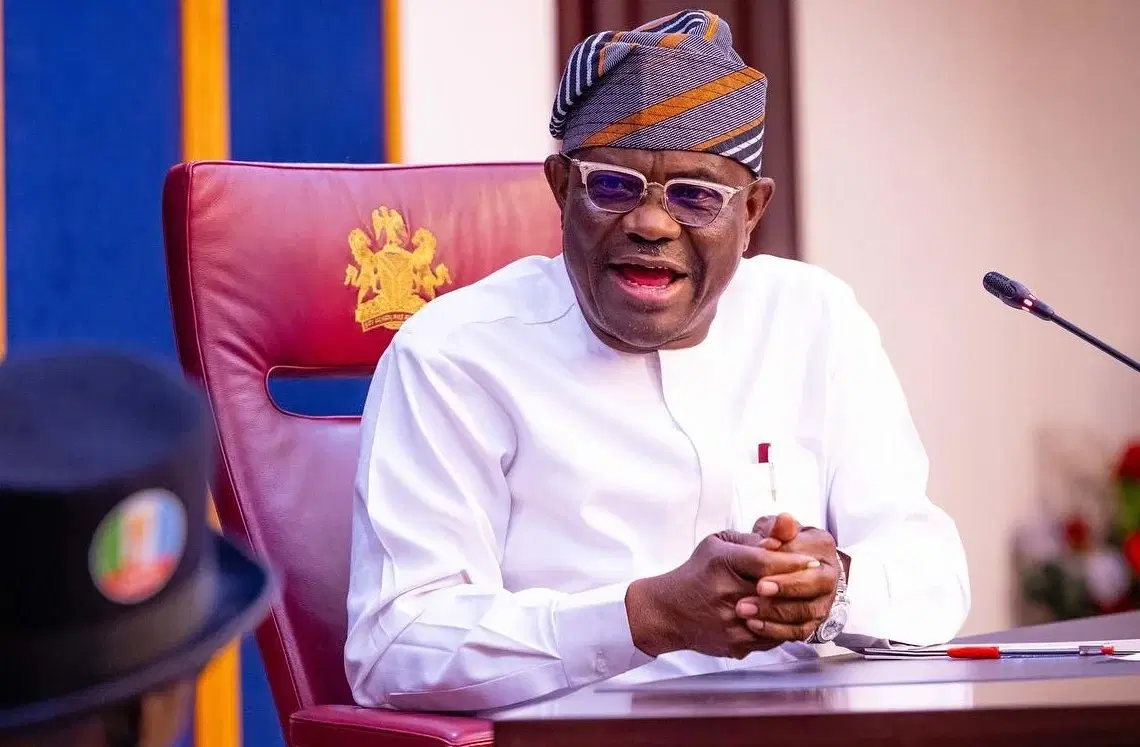
The Nyesom Wike–FCT Administration controversy is refusing to die down, and it is now turning into a bigger conversation about power, language, and press freedom in Nigeria. What started as a heated media chat on Friday has now sparked outrage from the camp of Atiku Abubakar, after comments made by Wike to broadcaster Seun Okinbaloye were interpreted as threatening.
On Saturday, the FCT Administration moved quickly to calm the storm, insisting that Wike’s comment was never meant to be taken literally. According to his Senior Special Assistant on Public Communications and Social Media, Lere Olayinka, the minister was simply speaking figuratively and trying to express frustration with the way the interview was handled.
Olayinka explained that Wike felt Seun had stepped out of the role of a neutral interviewer and appeared to be speaking like someone with a political stake in the discussion. In his view, the minister’s reaction was exaggerated language used to make a point, not a real threat. He also revealed that both men reportedly spoke on the phone after the incident, and that Seun understood the context of what was said.
The FCT Administration further argued that anyone who watched the programme in full should have understood that the remark was not intended as a serious act of violence. They pointed out that Wike himself immediately clarified during the live session that he did not mean he would literally pick up a gun and shoot the journalist. According to the minister’s camp, the studio atmosphere at that moment even reflected that the comment was not being treated as a real threat.
But while the FCT is trying to dismiss the matter as political exaggeration, the reaction from Atiku’s camp has been far from forgiving. The former vice president’s media office described the statement as reckless, disturbing, and dangerous, arguing that public officials — especially one as powerful and visible as Wike — should never speak in ways that can be interpreted as violent toward the media.
In a strongly worded response, Atiku’s camp said the issue goes beyond mere “banter.” To them, it reflects a worrying attitude toward criticism and journalism in Nigeria’s political space. They warned that when those in authority begin to use violent-sounding language against journalists, even casually, it sends a chilling message to the public and weakens democratic values.
The statement also suggested that the controversy is not just about one sentence made in the heat of the moment, but part of a wider culture where dissent is increasingly treated as hostility. According to the opposition, if a well-known TV anchor can be spoken to in such a manner on national television, ordinary Nigerians may begin to wonder how safe free expression really is.
Atiku’s media office is now demanding a full and public apology from Wike to Seun Okinbaloye and the wider Nigerian media community. They are also calling on the administration of President Bola Tinubu to openly reject any rhetoric that appears to threaten journalists or undermine press freedom.
At the centre of it all is a familiar Nigerian question: when powerful politicians speak “figuratively,” where should the line be drawn? For some, Wike was simply being dramatic, as he often is. For others, words from a man in power carry too much weight to be brushed aside as mere hyperbole.
What is clear is that this is no longer just about a tense TV exchange. It has become a fresh flashpoint in Nigeria’s already charged political atmosphere — one that is now forcing many to ask whether public discourse is becoming too hostile, too personal, and too dangerous.