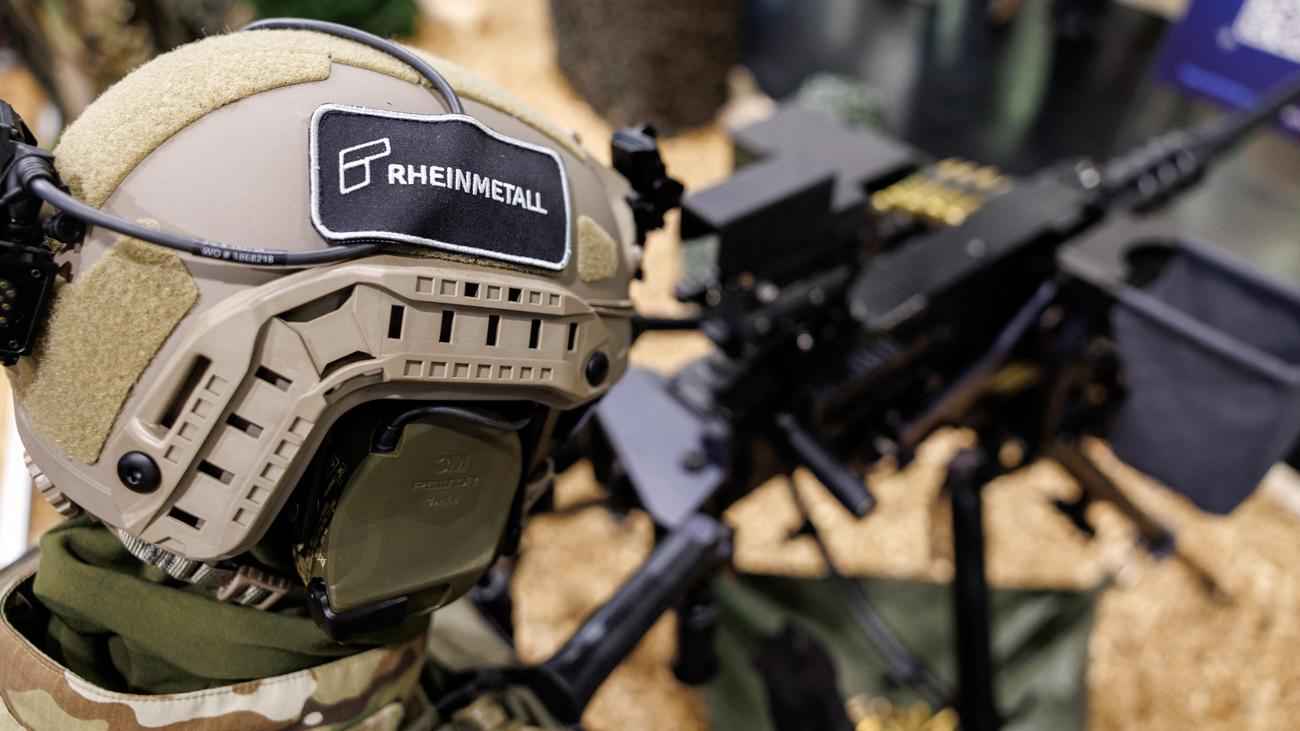
The arms company Rheinmetall has another billion-dollar order Bundeswehr announced. The Bundeswehr procurement office has placed an order worth 1.04 billion euros for infantry equipment, it said Announcement from the group.
The systems called “Infantryman of the Future – Advanced System” include protective vests, uniforms and night vision devices that are mounted on the helmet or weapon, as well as tablets that can be carried by army soldiers and are intended to provide an overview of enemy positions.
Existing equipment systems are also being modernized
Furthermore, the protection systems Rheinmetall equipped with software that provides superiors with a real-time overview of the positions of their soldiers and the enemy. However, the armament on which the systems can be carried is not part of the order.
Accordingly, the infantry systems for 8,600 soldiers are to be delivered between November 2027 and December 2029. The Bundeswehr will then have a total of 12,000 such systems, which, according to the company, could supply 353 trains. A platoon is a small tactical unit that usually includes more than 30 soldiers.
The order was placed within a 3.1 billion euro framework agreement concluded in February 2025, which is now being partially utilized. It therefore stands to reason that further orders of this type will follow. According to the company, the order that has already been placed includes not only new purchases but also the modernization of existing systems.
Rheinmetall expects large orders for at least another ten years
With the Bundeswehr’s planned upgrade in the coming years the federal government is planning to procure weapons and equipment worth hundreds of billions of euros. Rheinmetall is one of the biggest beneficiaries of the rearmament program.
Since the start of the Russian war against Ukraine, the group has significantly expanded its production capacity, and Rheinmetall’s share price has risen by more than 1,200 percent in the past four years. CEO Armin Papperger only expects the currently rising sales to slow down between 2035 and 2040.