By Erasmus Ikhide
IN the hallowed, albeit currently haunted, halls of Aso Rock, the silence is not merely deafening—it is complicit.
As the plumes of smoke rise from the streets of South Africa, signaling the latest inferno of xenophobic carnage where Nigerians are being hunted, burned, and slaughtered like prey, the Nigerian state has responded with a gesture of staggering indifference.
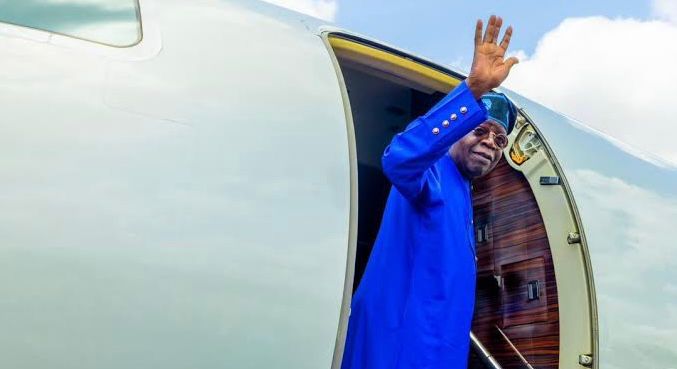
President Bola Ahmed Tinubu, in a move that encapsulates the utter decay of the Nigerian executive, has chosen this moment of national mourning to embark on a three-nation trip to Kenya, France, and Rwanda.
It is a profound irony that in the comity of nations, the erstwhile “Giant of Africa” has been reduced to a giant with clay feet—a hollowed-out behemoth whose citizens are treated as pariahs across the globe.
Why? Because the nation has been unfortunate to fall into the hands of an administration defined by a kleptomaniac streak, an abdicative posture, and a senile detachment from the realities of the governed.
The primary duty of any head of state is the protection of its citizens. Yet, for President Tinubu, that social contract appears to have been shredded. While the blood of Nigerians dries on foreign soil, our President occupies himself with the optics of travel—a joyride of diplomacy that serves no purpose for the dying Nigerian abroad or the starving one at home.
It is a spectacle of leadership that is not just archaic; it is inhuman.
The crisis of legitimacy—the fundamental truth that a government rigged into power cannot be expected to feel the pulse of the people—is the rot at the core of this tragedy.
When leadership is illegitimate, it is inevitably paranoid. It views the populace not as constituents to be protected, but as nuisances to be contained. This is the “Democracy of Rice”—a governance model where the vote is stolen, the ballot is a charade, and the only dividends distributed are the crumbs of a system that has perfected the weaponization of poverty.
Nigeria today is a country in retreat. The mass exodus—the Japa phenomenon—is not a trend; it is a mass evacuation from a sinking ship. Our citizens are not leaving because they are unpatriotic; they are leaving because they are survivors.
They flee a landscape of dreadful insecurity, where government-sponsored terrorists hold sway; they flee a grid where electricity is a mirage, hospitals are mere morgues, and the economy is a death trap.
We watch as the Naira loses its value in a freefall, while petroleum prices skyrocket to the heavens.
Each increment is a fresh nail in the coffin of the common man. The citizens are simply “water finding its level.” They are migrating to save themselves from a government that has taken everything from them—a government that feeds on the misery it creates, presiding over a landscape of starvation while the executive elite dances on the ruins.
If the “giant” still stands, it is only by the grace of its resilient, longsuffering people. But even resilience has a breaking point. A government that refuses to stand up for its citizens abroad has forfeited the moral authority to lead at home.
History will record that when the call came—when the lives of Nigerians were being extinguished in a foreign land—the Commander-in-Chief did not stand at the gates of diplomacy to demand justice. Instead, he boarded a plane.
Leadership is everything. Without it, education, research, and infrastructure become mere buzzwords in a bankrupt state. Nigeria is currently a testament to what happens when power is seized, not earned. And until the people reclaim their agency from those who treat the treasury as a personal piggy bank and the presidency as an instrument of self-aggrandizement, the blood of the innocent will continue to stain our national flag, both at home and abroad.
Tinubu’s decision to prioritize diplomatic jaunts to France, Kenya, and Rwanda while his citizens are being butchered in South Africa is not merely a tactical error; it is a profound historical misstep. He had the golden opportunity to stand as the modern avatar of Pan-Africanism, to be the voice that calls for sanity in the face of savagery.
Instead, he chose the comfort of the boardroom and the safety of the international circuit, effectively signaling to the world that Nigerian lives are expendable. By turning his back on Pretoria when the blood of our brothers and sisters was hot on the streets, he forfeited his chance to be mentioned in the same breath as the giants who defined the soul of this continent.
When we examine the pantheon of African legends—from the indomitable spirit of Kwame Nkrumah to the anti-corruption crusading of Thomas Sankara, or the reconciliation genius of Nelson Mandela—we see leaders who were forged in the crucible of crises.
These men did not manage their nations from the height of 30,000 feet; they walked into the eye of the storm to protect their people. By failing to board a flight to South Africa to confront the crisis directly, Tinubu has essentially vacated his seat at the table of honour.
He has shown the world that he is a manager of his own comfort, not a custodian of African destiny, failing to demonstrate the visceral courage that defined the legacies of Samora Machel, Kenneth Kaunda, or Patrice Lumumba.
The youth currently terrorizing fellow Africans in South Africa appear possessed by a toxic, xenophobic hypnotism, systematically dismantling the very African heritage that our forefathers bled to secure. A leader of true consequence would have met this darkness with the weight of sovereign authority, standing on South African soil to demand an immediate cessation of hostilities.
Had Tinubu stood before the South African populace, demanding accountability and upholding the dignity of the African citizen, he would have etched his name alongside the greats who prioritized the collective liberation of our people over the convenience of a presidential itinerary.
Look at the benchmarks of modern leadership set by the likes of Paul Kagame or Ellen Johnson Sirleaf. Their tenures are defined by the courage to face existential threats head-on and transform them into pillars of national pride. Tinubu had the opportunity to emulate this development-oriented resolve. Instead of facilitating a high-level, on-the-ground diplomatic intervention that could have curbed the carnage and solidified Nigeria’s position as the true regional stabilizer, he opted for the path of least resistance.
He chose to be a passive observer of the African tragedy rather than the architect of a solution.
Leadership is not merely a title held in an air-conditioned office; it is the courageous act of presence. It is the ability to stand between one’s people and the executioner’s blade. By abandoning his post at the height of this humanitarian emergency, President Tinubu has proven that his administration is untethered from the Pan-African ethos that built the modern African state.
He has chosen to be a tourist president rather than a transformative one, failing to grasp that the true test of a leader is not how many miles he clocks in the air, but how firmly he stands on the ground when his brothers are under attack.
Ultimately, history is rarely kind to those who choose convenience over conviction. By refusing to confront the xenophobic demon in the belly of the beast, Tinubu has missed his defining chance to distinguish himself as a titan of our time. He remains a figurehead who lacks the historical consciousness that defined the era of Julius Nyerere or Seretse Khama. In the annals of our history, this silence, this avoidance, and this travel schedule will stand as a permanent indictment—a testament to a presidency that watched the systematic destruction of the African dream from the window of a private jet, unmoved and disconnected.
Erasmus Ikhide contributed this piece via: ikhideluckyerasmus@gmail.com