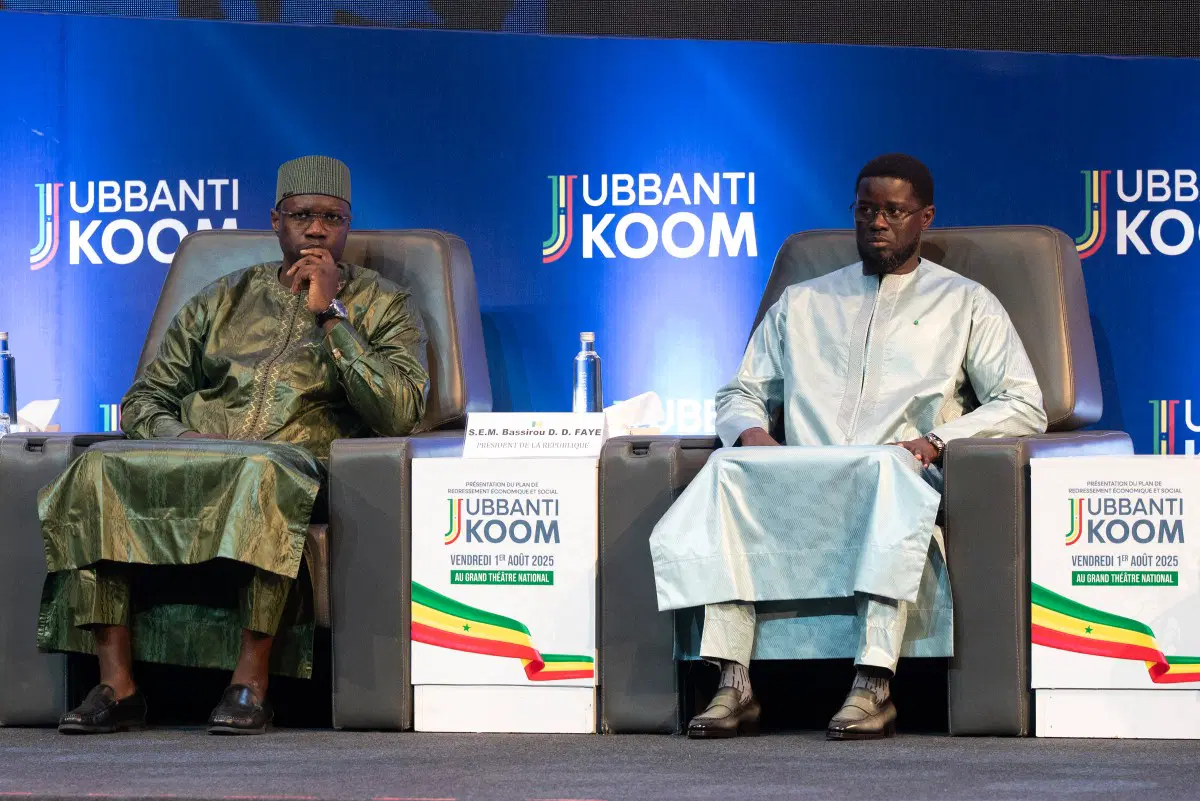
Senegal has been thrown into political uncertainty after President Bassirou Diomaye Faye dismissed Prime Minister Ousmane Sonko and dissolved the government on Friday, ending months of growing tension between the country’s two top leaders.
The announcement was made on national television through a presidential decree read by aide Oumar Samba Ba, confirming that Faye had “ended the duties” of Sonko along with all ministers and secretaries of state.
No immediate replacement for the prime minister was announced, leaving the country in a sudden leadership vacuum.
Shortly after his dismissal, Sonko reacted publicly on social media, expressing relief and defiance, posting that he would “sleep soundly” in his Dakar neighbourhood of Keur Gorgui. He later returned home to a crowd of supporters who gathered to show solidarity with him.
The dramatic move highlights the deepening cracks within Senegal’s ruling political structure. Faye and Sonko, once political allies under the Pastef movement, rose to power in 2024 on promises of major reform, anti-corruption measures, and economic recovery. However, their relationship has deteriorated in recent months amid disagreements over governance style and political direction.
While Sonko remains a highly influential figure with strong youth support, especially for his pan-Africanist stance, President Faye retains constitutional authority to appoint and dismiss the prime minister, giving him ultimate control of the executive arm.
The crisis is unfolding at a difficult time for Senegal, which is struggling with a heavy debt burden estimated at over 130% of GDP, according to international financial reports. Analysts say the political fallout could further complicate efforts to stabilise the economy and restore investor confidence.
As uncertainty grows, attention now shifts to who President Faye will appoint next—and whether the ruling coalition can survive this major internal rupture.