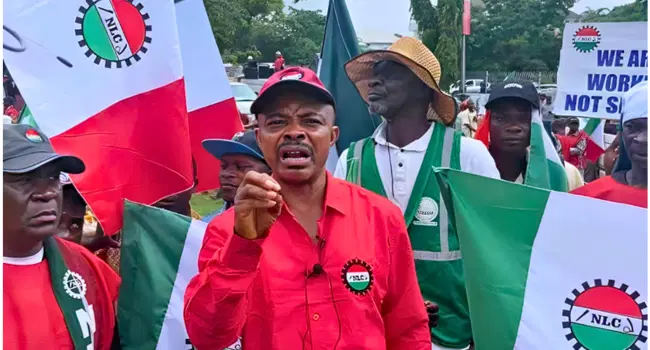
Nigeria’s labour movement has raised a strong alarm over the worsening state of the country, warning that many citizens—especially workers—are no longer living, but simply trying to survive.
The President of the Nigeria Labour Congress (NLC), Joe Ajaero, painted a grim picture of daily life, linking rising insecurity, poverty, and economic hardship to what he described as a national crisis.
According to him, insecurity has reached a level where it is no longer just a security issue—it is now directly affecting jobs, productivity, and the ability of Nigerians to earn a living.
“People can no longer go to their farms or workplaces safely,” he said, noting that many have been forced to abandon their homes and move into safer areas or displacement camps.
For workers, this has created a harsh reality.
The conversation is no longer about decent work—but about whether there is work at all.
At the same time, the economic pressure continues to mount.
Fuel prices have risen sharply, transportation costs have increased, and the cost of living keeps climbing. Yet, according to labour leaders, wages have largely remained unchanged.
For many Nigerians, this gap between income and expenses is becoming unbearable.
Ajaero questioned why improvements in government revenue and economic indicators are not translating into better living conditions for ordinary citizens.
“If the economy is growing, why are people still struggling to move from one place to another?” he asked.
The removal of fuel subsidy remains a key point of concern.
While the government, through Finance Minister Taiwo Oyedele, has insisted that subsidy will not return, labour leaders argue that the policy has significantly increased hardship without providing adequate alternatives.
They point out that expected solutions—such as affordable transport systems or alternative energy options—are either not available or not accessible to the average Nigerian.
Beyond fuel and income, the burden of daily life is also growing heavier through taxes and levies.
From market traders to commercial riders, many Nigerians now face multiple layers of charges before they even begin to earn for the day.
According to the NLC, this is pushing more people into poverty and deepening inequality.
The labour body also raised concerns about working conditions, especially in parts of the private sector, where workers are said to face long hours, unsafe environments, and limited protection.
Even the right to protest, Ajaero noted, is increasingly being challenged, despite growing frustration across the country.
Perhaps most striking is the broader message behind the warning:
When people cannot afford food, transportation, or safety, it becomes more than an economic issue—it becomes a human one.
For the NLC, the situation demands urgent attention, practical solutions, and policies that directly improve the lives of ordinary Nigerians.
Because, as the reality stands today,
for many citizens, survival has taken the place of living.